 DegreePlus Daily The skills that make your degree pay off
Data Engineering vs Data Science for BTech Graduates – Which Path Hires More Reliably in 2026
A comparison that names the real differences, not just the salary headlines
By Chinnagounder Thiruvenkatam, Published June 16, 2026
Two job titles appear together so often in career discussions that they begin to blur into each other. Data engineer. Data scientist. Both sit inside tech teams. Both work with large amounts of data. Both command strong salaries. And for a BTech graduate trying to choose a direction, the question of which one to pursue is genuinely difficult to answer from the outside – because the work itself is quite different, the path to each is quite different, and the hiring reality in 2026 is more nuanced than the comparison articles that flood the internet suggest.
This article tries to give a clear, honest answer. It is written for BTech graduates in Computer Science, Information Technology, or related engineering streams who are at a decision point about which data career to pursue – not because they want to follow a trend, but because they want to make a well-informed choice about where to invest the next twelve to eighteen months of learning.
The short answer, which I will explain in detail below, is that data engineering is hiring more reliably at entry level in 2026. The reasons are specific and worth understanding, because the better long-term path for any individual depends on temperament and mathematical background as much as on market conditions.
What each role actually does
The titles are often used loosely, which causes unnecessary confusion. Before comparing salaries and job numbers, it is worth being precise about what the work involves.
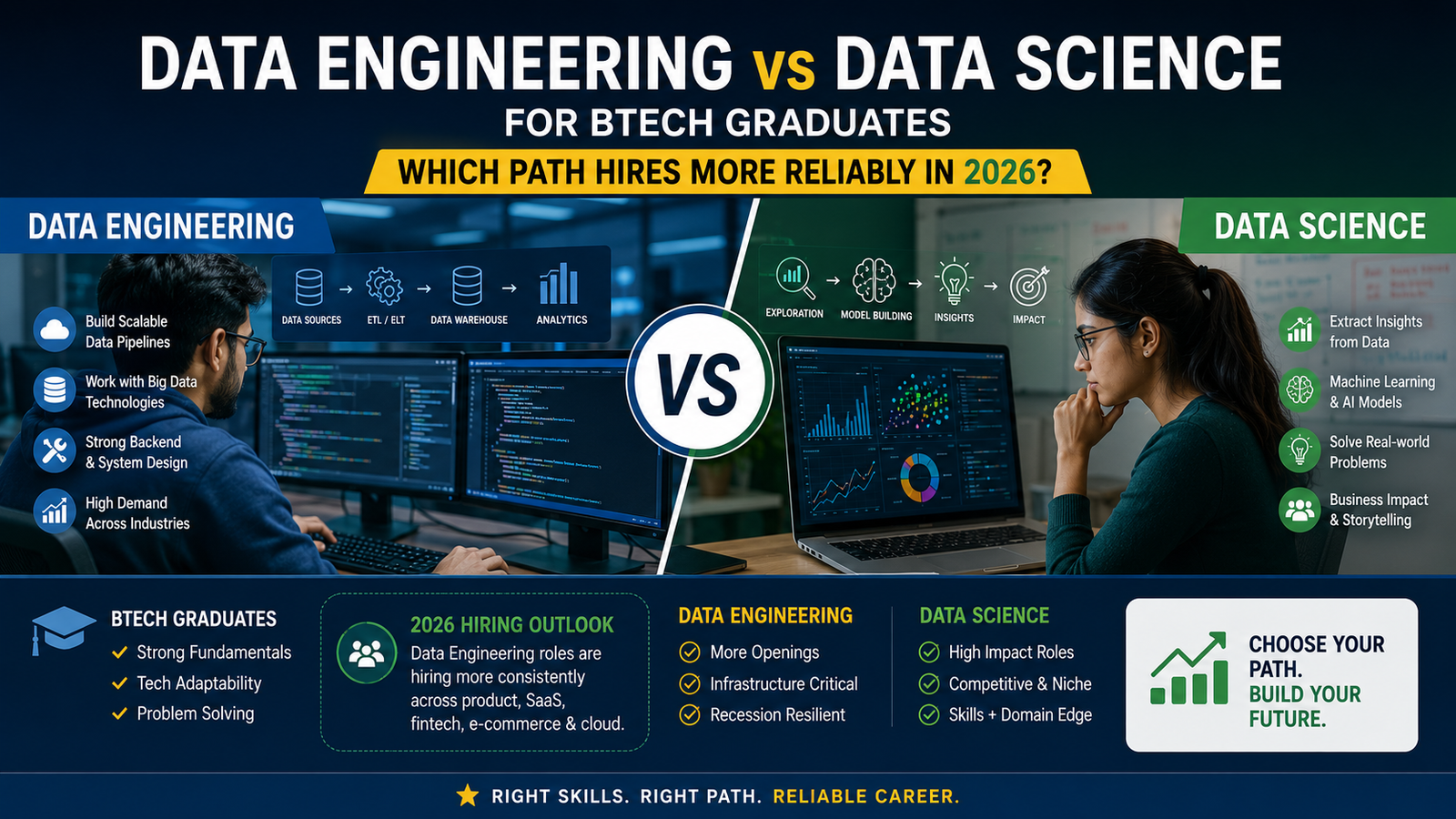
A data engineer builds and maintains the systems that make data available for analysis and decision-making. The work is fundamentally about infrastructure – designing pipelines that move data from source systems into storage, building the databases and data warehouses that hold it, ensuring that data arrives reliably, at scale, and in a form that can be used. A data engineer’s daily work involves writing code in Python and SQL, working with cloud platforms and their data services, building and monitoring automated workflows, and solving the problems that arise when large-scale data systems behave unexpectedly. The output of their work is not an insight or a prediction. It is a reliable, well-functioning system.
A data scientist applies statistical and machine learning techniques to data to generate insights, build predictive models, and answer business questions that cannot be answered by looking at a dashboard. The work involves understanding a business problem precisely, selecting and applying appropriate analytical methods, interpreting results with enough statistical rigour to draw valid conclusions, and communicating findings to people who will act on them. The daily work involves Python or R for statistical analysis, machine learning libraries, statistical reasoning, and a significant amount of translating between technical findings and business implications. The output of their work is knowledge – a model that predicts something useful, an analysis that answers a question, an insight that guides a decision.
The two roles intersect, and at many companies the boundaries between them are blurry. But the underlying orientation is genuinely different. Data engineering is closer to software engineering – building systems that work reliably. Data science is closer to applied research – using data to answer questions. This distinction matters for two reasons. It determines which type of person will find the work genuinely satisfying, and it determines which skills you need to develop to do each job well.
What the 2026 market shows
The headline salary figures for both roles are strong, and citing them without context does not help a BTech graduate make a decision. So I will give the numbers and the context.
For data engineering, the field employs over 150,000 professionals in the US and added more than 20,000 new positions in the past year according to current job market data. The average data engineer salary sits at around 130,000 dollars annually, with entry-level positions starting around 106,000 dollars and senior engineers reaching 147,000 to 179,000 dollars nationally. In major tech hubs like San Francisco, senior roles reach up to 232,000 dollars. The US Bureau of Labor Statistics classifies data engineers among the fastest-growing tech roles. Infrastructure investment in cloud platforms, real-time analytics, and AI systems is driving consistent, sustained demand.
For data science, the BLS projects 34 percent employment growth through 2034 – one of the strongest projections in the entire occupational database. The average data scientist salary is around 129,753 dollars, with mid-level professionals nationally earning between 138,000 and 175,000 dollars. The role commands marginally higher average total compensation than data engineering at equivalent experience levels.
Both sets of numbers are good. Neither career is a poor choice from a salary perspective. The question is which one is easier to enter from a BTech graduate starting point in 2026, and here the picture is more differentiated.
Data engineering is currently hiring more reliably at entry level. One well-regarded analysis of 2026 data team composition found that infrastructure investment is outpacing analytics and science hiring – data engineering is growing as a share of data team composition, not just in absolute numbers. Companies are building or scaling their data infrastructure faster than they are expanding their analytical science teams. This means more open positions at the junior end, which translates directly into more realistic entry points for graduates.
Data science entry-level hiring has tightened. The supply of data science graduates from dedicated master’s programmes, online boot camps, and computer science programmes has grown substantially over the past five years, while the number of genuinely junior data science roles – roles where a new graduate can produce useful work without significant supervision – has not grown at the same pace. Entry-level data science positions have become more competitive as a result, and employers have raised their expectations accordingly. A position that two years ago hired a BTech graduate with solid Python and some machine learning coursework now frequently expects one to two years of applied experience or a master’s degree with demonstrated project work.
This does not mean data science is inaccessible to BTech graduates. It means the path there typically runs through either a data analyst role or a data engineering role first, building real applied experience before transitioning toward more science-focused work. Treating data science as the direct entry point from a BTech degree, without intermediate applied experience, leads many graduates to underestimate the competition and the expectations.
The skills each path requires – and what BTech already provides
A BTech degree in Computer Science or a related engineering stream provides a genuine foundation for both paths, but the distance from that foundation to job-ready capability differs.
For data engineering, the BTech foundation covers the relevant theoretical ground well. Understanding of databases, operating systems, networking, and programming gives a BTech graduate a real starting point. The additional skills that close the gap to entry-level employability are specific and learnable: SQL at an intermediate to advanced level, Python for data processing with the standard libraries used in production environments, familiarity with at least one major cloud platform and its data services (which overlaps directly with the cloud certifications discussed in an earlier Tech Plus article on this site), and hands-on experience building and running a data pipeline on real data. This gap can be closed in six to twelve months of focused, applied work.
For data science, the BTech foundation covers programming and some mathematics, but the depth of statistical and mathematical knowledge that senior data scientists use – probability theory, statistical inference, linear algebra applied to machine learning, model evaluation methodology, experimental design – goes beyond what most BTech programmes teach comprehensively. A BTech graduate who has strong mathematics from their programme and genuine interest in statistical reasoning is well-positioned to develop these skills. A graduate whose mathematical foundation is weaker, or who finds statistical reasoning less engaging than systems building, will find the path to genuine data science competence longer and harder than the salary headlines suggest.
The practical implication is worth saying clearly. If your BTech programme was strong in mathematics and you genuinely enjoyed the quantitative and analytical subjects, data science is a realistic aspiration and the path is achievable without a master’s degree, though it requires deliberate investment in statistical and machine learning skills beyond standard BTech content. If your BTech programme was stronger in systems and software development, or if you find analytical and statistical work less engaging than building and engineering, data engineering is both the more natural fit and the more accessible entry point.
The honest temperament question
Salary articles consistently avoid asking whether you would actually enjoy the work, and this omission costs people years. Both data engineering and data science produce competitive salaries. The difference in financial outcome between choosing one over the other is marginal compared to the difference in day-to-day experience if you choose a path that does not suit your working style.
Data engineering suits people who find genuine satisfaction in building things that work reliably. The work is largely about systems, code, and infrastructure – making data pipelines that run without failing, building databases that perform under load, solving the specific technical problems that arise when large-scale systems encounter unexpected data. There is a clear feedback loop between the work and its outcome: either the pipeline runs or it does not. Either the data arrives correctly or it does not. People who enjoy that clarity, who find systems problems interesting, and who are energised by infrastructure work tend to thrive in data engineering.
Data science suits people who are genuinely curious about using data to answer questions, who are comfortable sitting with ambiguity while an analysis develops, and who find the intersection of mathematics and real-world problems intrinsically engaging. The feedback loop in data science is slower and less clear than in engineering. You can spend weeks on an analysis that produces an equivocal result. You can build a model that performs well in testing but fails to produce useful business predictions in production. People who find this process intellectually rewarding rather than frustrating are naturally suited to data science work.
Neither temperament is better. They are different, and the work of each role reflects the difference clearly. Choosing based on which salary looks slightly higher, rather than which type of work actually suits you, is one of the more reliable paths to a career that pays well but feels wrong.
A practical recommendation for 2026
For a BTech graduate making this decision in June 2026, here is my honest recommendation based on the market and the evidence.
If you are genuinely uncertain between the two and your mathematical background is not significantly stronger than your systems background, start with data engineering. The entry is more accessible, the path from BTech to job-ready capability is shorter, the market has more open positions at the junior level, and the skills you build – cloud platforms, SQL, Python for data processing, pipeline architecture – are directly transferable to data science work if you later decide to move in that direction. Many experienced data scientists have backgrounds in data engineering or data analysis, because applied experience with real data systems produces the intuition that pure coursework does not.
If your mathematical background is strong, you find statistical reasoning genuinely engaging, and you have already done project work involving machine learning or statistical analysis that you found rewarding, data science is a realistic direct target. Invest in deepening the statistical foundation, build a portfolio of genuine analytical projects on real datasets, and approach entry-level positions understanding that the competition is higher and the expectations include more demonstrated applied experience than they did a few years ago.
How to Identify and Bridge Your Skill Gap After Graduation – A Practical 2026 Guide
Cybersecurity Certifications for BTech Graduates – An Honest 2026 Guide
The Skills That Will Keep Your Degree Relevant Through 2026 and Beyond
BTech Computer Science in 2026: The Five Skills Tier 1 Tech Employers Actually Test For
In either case, the cloud skills covered in the cloud certification article earlier on this site, and the portfolio-building approach described in the skill gap article, apply directly to both paths. The specific cloud data services – managed database services, data warehousing, streaming data platforms – are relevant to data engineering. The analytical and visualisation tools are relevant to data science. Building real projects on real data, and making those projects publicly visible, is the single most consistent differentiator between BTech graduates who get interviewed for data roles and those who do not.
If you are working through this decision and want to share your specific background and target to get a more specific perspective, write to me at editor@degreeplusdaily.com. I read every email.
- Chinnagounder Thiruvenkatam, Publisher and Editor