 DegreePlus Daily The skills that make your degree pay off
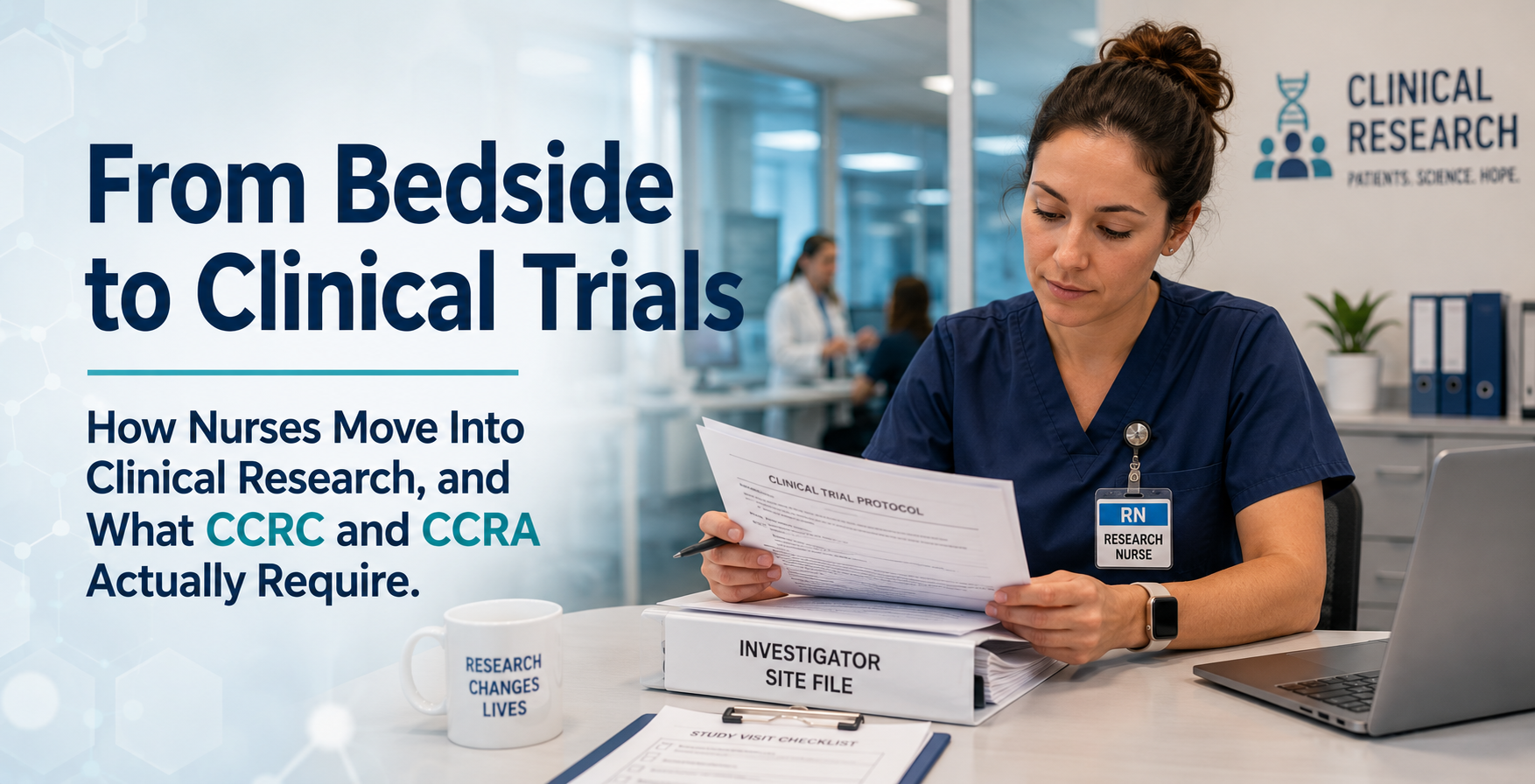
From Bedside to Clinical Trials – How Nurses Move Into Clinical Research, and What CCRC and CCRA Actually Require
The entry route no course seller will explain, and the certification facts that change your plan
If you are a nurse thinking about moving into clinical research, the honest answer to your first question is simple and slightly surprising: you do not need to buy a certification to enter this field, and in fact you cannot. The two certification bodies that matter, ACRP and SOCRA, both require substantial verified work experience in clinical research before they will even let you sit their exams. Certification in this field is proof that you have already done the work. It is not a ticket in.
That single fact restructures the entire plan. The real path for a nurse runs through a job first – almost always a clinical research coordinator role at a hospital, university, or research site – and the certification comes one to two years later. Everything else in this article builds on that sequence, because most of what ranks online for this topic gets the sequence backwards, usually because the page you are reading is trying to sell you a course.
Why clinical research keeps hiring nurses specifically
Clinical trials are medical care under a protocol. Someone has to consent patients, administer investigational products, monitor adverse events, take vitals, draw samples, document everything to an audit standard, and talk to worried participants in plain language. That job description is a nursing job description. Research sites know it, which is why nursing is one of the most common backgrounds among clinical research coordinators worldwide.
Your bedside years are not something to explain away in this transition. They are the qualification. A nurse who has managed medication administration records, escalated deteriorating patients, and survived a hospital accreditation audit already thinks the way trial protocols demand. What you are missing is narrower than you might fear: the regulatory framework, the documentation conventions specific to trials, and the vocabulary.
The field also offers something bedside nursing increasingly does not. Coordinator and monitoring roles are largely daytime, weekday work. For nurses leaving night shifts and mandatory overtime behind, that alone is often the reason the move gets made. The trade-off is real too, and worth stating plainly: you give up the direct clinical relationship, much of the work is documentation, and the entry salary at a research site can sit below what an experienced acute-care nurse earns with differentials. The financial gain in this career usually arrives at the second step, not the first.
The three job titles, and which one is your actual entry point
The titles in this field confuse almost everyone at the start, so it helps to fix them early.
A clinical research coordinator, or CRC, works at the site where the trial happens – the hospital or clinic. Coordinators run the trial day to day: screening and consenting participants, scheduling visits, collecting data, maintaining regulatory files. Sites hire nurses into these roles regularly, and some coordinator postings ask for an RN specifically because the protocol involves clinical procedures. A closely related title, clinical research nurse, describes the same territory with more hands-on patient care. Either one is your realistic entry point.
A clinical research associate, or CRA, works for the other side – the sponsor running the trial, or a contract research organisation hired by the sponsor. CRAs monitor multiple sites, travelling or reviewing remotely to verify that each site follows the protocol and that the data is accurate. CRA roles pay considerably more than coordinator roles and are the destination most people in this field aim for. They are almost never entry-level. The standard route to a CRA position runs through one to three years of coordinator experience first.
Above and around these sit project managers, drug safety specialists, and regulatory affairs roles, all of which recruit from the coordinator and CRA population. The career ladder is genuine, which is part of why the field rewards patience with the first step.
What ACRP certification actually requires
The Association of Clinical Research Professionals offers role-specific credentials: CCRC for coordinators, CCRA for monitors, CPI for investigators, and a role-neutral ACRP-CP. According to ACRP’s published certification handbook, eligibility for these exams requires 3,000 hours of verifiable work experience performing the tasks in the exam’s content outline. Experience older than ten years does not count. ACRP may substitute up to 1,500 of those hours for candidates who hold another active ACRP credential or who graduated from a clinical research degree program holding recognised accreditation, but no candidate reaches zero. There is no version of this in which a bedside nurse with no research experience sits the CCRC exam next month.
Three thousand hours is roughly eighteen months of full-time work. In practice, a nurse who takes a coordinator job can expect to become CCRC-eligible somewhere in her second year. ACRP’s exams are built on the ICH Good Clinical Practice guideline rather than any single country’s regulations, run in fixed spring and autumn testing windows, and renewal requires continuing education credits every two years.
What SOCRA certification actually requires
The Society of Clinical Research Associates takes a different approach. Instead of separate credentials per role, SOCRA offers one certification, the CCRP, covering coordinators, monitors, investigators, and other research professionals under a single exam. SOCRA’s published eligibility criteria offer several qualification categories. The one most working candidates use requires two years of full-time employment as a clinical research professional within the past five years, with a part-time equivalent defined in hours. Other categories reduce the experience requirement for candidates who completed formal clinical research degree or certificate programs.
Two details in SOCRA’s program documents matter more than they first appear. The CCRP is accredited by the National Commission for Certifying Agencies, and TransCelerate BioPharma recognises the credential as evidence of Good Clinical Practice training – a practical point, since GCP training is something research employers ask about at hiring. SOCRA also offers testing year-round, through test centres or proctored from home, where ACRP holds two windows per year. The exam content rests on the US Code of Federal Regulations and the ICH GCP guideline, and from January 2026 reflects the updated E6 R3 revision of that guideline, so any preparation material you use needs to be current.
On cost, both bodies price their exams in the low hundreds of US dollars, with membership discounts, retest fees, and periodic increases that make any figure printed in an article unreliable within a year. Both organisations publish current fees on their official sites, and checking there before budgeting is the only method I will recommend.
CCRC or CCRP – how a nurse should choose between the bodies
For a nurse entering through a coordinator role, the practical differences come down to four things. ACRP’s CCRC is role-specific and requires a new exam if you later move to monitoring, where SOCRA’s single CCRP travels with you across roles. ACRP requires renewal every two years against SOCRA’s three. SOCRA’s year-round testing fits unpredictable schedules better than ACRP’s fixed windows. And some employers, particularly certain contract research organisations, name a preference for one body in their job postings, which outranks every other consideration if you know where you want to work.
Neither credential is the wrong choice, and hiring managers in this field respect both. The site’s earlier decision framework for choosing a certification applies here in full: the certification that matches your next role and your actual employer’s preference beats the one with the better marketing. If you have no employer signal to follow, the single-credential flexibility and year-round testing make SOCRA’s CCRP the simpler default for a career changer, while ACRP’s role-specific CCRA carries weight when you make the move into monitoring later.
The honest problem with the course-selling industry around this field
While researching this article I searched the way any nurse would search, and the results were uniform in a way I have rarely seen even in the certification world. Nearly every page that ranks for these terms is published by a company selling a clinical research course, a contract research organisation recruiting for itself, or a test-preparation business. I could not find one ranking page that leads with the fact both certification bodies print plainly in their own eligibility documents: the experience requirement comes first, and no purchased course removes it. When every voice answering a question profits from one particular answer, the question deserves an independent answer. That is why this article exists.
To be fair and precise: formal clinical research education is not worthless. Both bodies reduce their experience requirements for graduates of recognised programs, and a structured course can genuinely help a candidate who learns best that way. What a course cannot do is substitute for entry. If your budget is limited, the highest-value preparation is free – the ICH E6 Good Clinical Practice guideline is published in full on the ICH website, and it is the primary document both exams are built on. A nurse who reads it before her first research interview walks in ahead of most applicants.
A realistic transition plan from where you stand now
The sequence that fits the evidence looks like this. While still at the bedside, read the ICH GCP guideline and learn the vocabulary of trials – protocol, informed consent process, adverse event reporting, source documentation. If your hospital runs any research, ask to be involved in whatever capacity exists; internal transfers into research departments are one of the most common entry routes because the site already trusts your clinical record. Then apply for clinical research coordinator and clinical research nurse roles, leading your application with the specific clinical skills trials need: consent conversations, medication administration, documentation discipline, patient monitoring.
Once hired, log your start date. Your eligibility clock for both ACRP and SOCRA begins with the job, not with any course. Somewhere in your second year, choose the certification body that matches your employer and your next intended role, and sit the exam while the daily work is still fresh. If monitoring is your goal, start building toward CRA applications at the same time, because coordinator experience plus a current certification is exactly the profile CRA hiring looks for.
The nurses who stall in this transition are usually the ones who spent their first year comparing courses instead of applying for jobs. The ones who move fastest treated the coordinator role itself as the qualification, which is what it is.
The international dimension for internationally trained nurses
Readers of this site’s international nursing registration coverage should note one welcome difference. Clinical research employment is not licensure-gated the way bedside practice is. A coordinator role generally does not require registration with the NMC, a US state board, or AHPRA unless the specific position involves clinical procedures that legally require a licensed nurse. For an internationally educated nurse whose registration process is still in progress, research coordination can be employment in the field of healthcare that does not wait on the licensing timeline – subject entirely to the immigration and work-authorisation rules of the country in question, which this site does not advise on.
The degree question from the BSc Nursing or GNM analysis carries over in softer form. Research employers in the US, UK, Canada, and Australia typically list a bachelor’s degree in a health or life science as their baseline for coordinator roles, so a degree-qualified nurse meets the standard requirement directly, while a diploma-qualified nurse will find fewer doors open and should read individual postings closely rather than assume exclusion.
How to Identify and Bridge Your Skill Gap After Graduation – A Practical 2026 Guide
How to Get Certified in Health Informatics – A Step-by-Step Guide for 2026
Compliance as a Career Path for Law Graduates – An Honest Look at 2026
Cybersecurity Certifications for BTech Graduates – An Honest 2026 Guide
The Skills That Will Keep Your Degree Relevant Through 2026 and Beyond
Questions nurses actually ask about this move
I have four years of ICU experience. Can I apply directly for CRA jobs and skip the coordinator step?
Occasionally a CRO will hire a strong clinical background directly into a trainee monitoring program, and it costs nothing to apply. Plan around the normal case anyway: coordinator first, CRA at the one-to-three-year mark. The ACRP CCRA exam’s 3,000-hour requirement means even a direct CRA hire cannot be certified at entry.
Do I lose my nursing registration if I move into research?
Moving into research does not cancel a registration. Whether the registration remains active depends on your regulator’s renewal and practice-hour rules, which vary by country and are worth checking before you assume either way. Many research nurses deliberately maintain registration because it keeps clinical roles open and is required for some research positions.
Is a paid clinical research certificate course ever worth it before my first job?
Sometimes, for the right person – it can strengthen a CV that has no research exposure at all, and graduates of recognised programs qualify for reduced experience requirements at both certification bodies. It is never required, and it never replaces the experience requirement entirely. Read the eligibility pages at acrpnet.org and socra.org before paying anyone anything.
My hospital has a research department. Should I apply externally or transfer internally?
Try internal first. Research departments hire nurses they already know at a rate external applicants never enjoy, and an internal move lets you keep pension and seniority arrangements that an external jump resets.
If your situation does not match any scenario above – a different qualification, a different country, a posting you are unsure about – write to me at editor@degreeplusdaily.com. I read every email, and reader questions decide what this site researches next.
Data sources: ACRP official certification handbook and published eligibility criteria (acrpnet.org), SOCRA official CCRP eligibility criteria and certification program documents (socra.org), ICH E6 Good Clinical Practice guideline (ich.org) as published by the International Council for Harmonisation, TransCelerate BioPharma recognition of the CCRP as stated in SOCRA program documentation.