 DegreePlus Daily The skills that make your degree pay off
Which credentials genuinely open doors, which to skip, and the order that makes sense
Cybersecurity is one of the few areas of the technology job market in 2026 where demand still clearly outstrips supply. While entry-level software engineering hiring has tightened and graduates compete hard for fewer openings, the security field continues to grow at a pace that the supply of qualified people cannot match. For a BTech graduate trying to decide where to point their effort, this makes cybersecurity worth serious consideration – but only if you go about it in the right way, because the cybersecurity certification market is also crowded with credentials that cost money and deliver very little.
This article is an honest guide to cybersecurity certifications for BTech graduates – those in Computer Science, Information Technology, Electronics, or related engineering streams who are considering a security career. It explains which certifications genuinely carry weight with employers, which ones to skip, the sensible order to pursue them in, and what the honest salary picture looks like.
A guide on legal AI tools and a guide on cloud certifications already exist on this site for readers weighing other tech directions. This one addresses security specifically, because it has become one of the most common questions readers ask.
Why cybersecurity is worth considering in 2026
The numbers behind cybersecurity demand are genuinely strong, and they come from credible sources rather than marketing material.
The US Bureau of Labor Statistics reported a median annual salary of 124,910 dollars for information security analysts as of May 2024 – more than double the national median salary for all occupations. The Bureau projects employment in this category to grow by around 33 percent through the early 2030s, a rate several times faster than the average across all occupations. This is not a field where demand is speculative or dependent on a single technology trend. The need for security professionals grows every time an organisation digitises a process, adopts a cloud service, or connects a new system to the internet – which is to say, constantly.
There is also a clear, measurable return on certification in this field specifically. The Bureau of Labor Statistics found that workers holding a relevant certification in 2025 earned a median weekly wage of around 1,566 dollars, compared to roughly 1,131 dollars for those without certification. That gap is substantial, and in cybersecurity it is particularly pronounced because many security roles – especially those connected to government, defence, and regulated industries – formally require specific certifications. In those roles, the certification is not a nice-to-have that strengthens your resume. It is a gate. Without the named credential, you are not eligible for the position regardless of your actual ability.
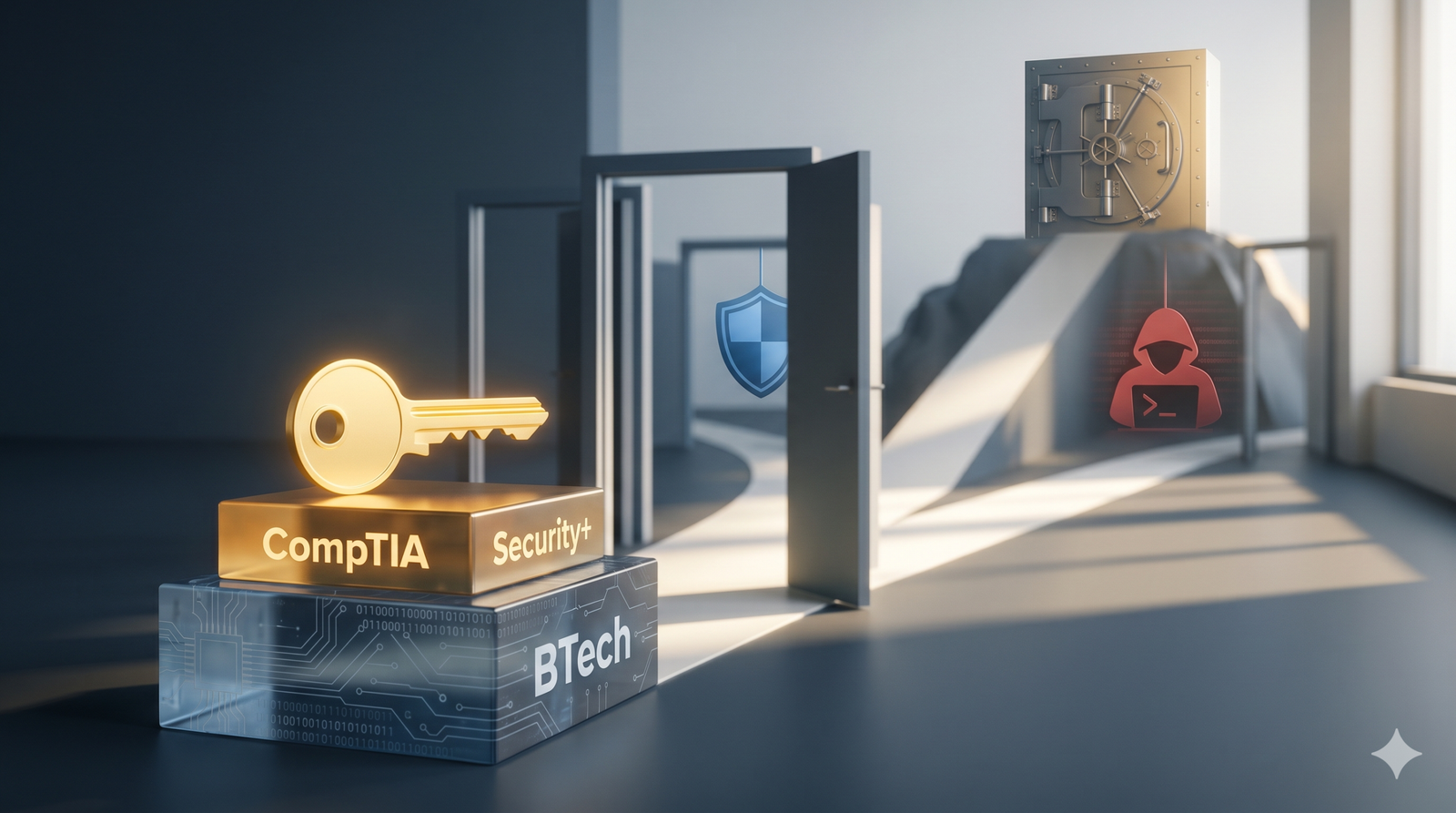
For a BTech graduate, this combination – strong demand, high salaries, faster-than-average growth, and a clear certification-to-salary link – makes cybersecurity one of the more rational specialisations to pursue. The honest caveat, which the next sections address, is that the entry-level security market still expects you to demonstrate genuine capability, and the wrong certification choices waste both money and time.
What a BTech degree gives you, and what security work additionally demands
A BTech in Computer Science or a related stream gives you a real foundation for security work – an understanding of operating systems, networks, databases, and programming. Security work draws directly on all of these. A person who understands how a network actually moves data, how an operating system manages permissions, and how an application handles input is far better positioned to understand how those same systems can be attacked and defended.
What the degree does not give you is the specific, security-focused knowledge that employers expect even at entry level – a working understanding of threat types and attack methods, familiarity with security tools such as firewalls and intrusion detection systems, knowledge of security frameworks and compliance requirements, and the particular mindset that security work demands, which is the habit of thinking about how systems fail and how they are misused rather than only how they function as intended.
This security-specific layer is what certifications are designed to build and validate. The good news for BTech graduates is that the engineering foundation makes that layer faster to acquire than it would be for someone entering security from a non-technical background.
The certifications worth pursuing, and the sensible order
Start here – CompTIA Security+
For the overwhelming majority of BTech graduates entering cybersecurity, CompTIA Security+ is the correct first certification. It is the most widely recognised entry-level security credential, and it is requested by name in a very large share of entry-level security job postings.
The current exam, version SY0-701, costs 392 dollars for a single attempt. It contains a maximum of 90 questions to be completed in 90 minutes, and the passing score is 750 on a scale of 900, which works out to roughly 83 percent. There are no formal prerequisites, although CompTIA suggests candidates have some prior IT familiarity – and a BTech graduate comfortably meets that informal expectation. The exam covers threats, attacks and vulnerabilities, security architecture, security operations, and governance and compliance.
Security+ matters for one reason beyond its broad recognition – it satisfies several US Department of Defense baseline requirements under the 8140 framework. This means that for a wide range of government and defence-contractor security roles, Security+ is the credential that makes you formally eligible to hold the position. Even outside government work, hiring managers across security operations centres, compliance teams, and systems administration treat it as the standard proof of foundational security knowledge.
The realistic preparation time for a BTech graduate is six to ten weeks of consistent study. The total cost, including the exam fee and reasonable self-study materials, can be kept under 500 dollars. This is the credential to begin with, and for many BTech graduates it is enough on its own to secure a first security role.
What to consider next, depending on direction
After Security+, the right next step depends on which part of the security field you are moving toward. Cybersecurity is not a single career – it branches into distinct paths, and the second certification should follow your chosen branch rather than being chosen at random.
If you are drawn toward defensive security operations – working in a security operations centre, monitoring systems, responding to incidents – the natural next steps are credentials focused on incident handling and security operations. CompTIA’s CySA+ (Cybersecurity Analyst) is a reasonable continuation within the same certification family, focused on threat detection and analysis. It is appropriate once you have Security+ and some practical exposure.
If you are drawn toward offensive security – penetration testing, finding vulnerabilities before attackers do – the credential that carries genuine weight with hiring managers is the OSCP, the Offensive Security Certified Professional. The OSCP is respected because it is genuinely difficult and entirely practical. It requires candidates to actually compromise systems in a controlled examination environment rather than answer multiple-choice questions. It is not an entry-level certification and should not be attempted as a first or second credential. It is a goal to work toward over one to two years, after you have built foundational knowledge and hands-on skill. But for offensive security specifically, it is worth more in the eyes of most hiring managers than alternatives that rely on theoretical examination.
If you are drawn toward cloud security – an area of fast-growing demand given how completely organisations have moved to cloud infrastructure – the sensible path combines security fundamentals with cloud-platform knowledge. A foundational cloud certification, of the kind discussed in this site’s cloud certification guide, paired with Security+, positions a BTech graduate well for cloud security roles, which sit among the better-compensated parts of the field.
The senior credential to know about but not yet pursue
The CISSP, the Certified Information Systems Security Professional, is the most recognised senior credential in the field, and it is worth knowing about even though it is not appropriate for a BTech graduate to pursue now. The CISSP formally requires five years of cumulative paid work experience in security before you can be fully certified. A candidate can pass the examination earlier and hold an associate status while accumulating the required experience, but the credential itself is designed for established professionals.
The reason to know about it now is direction. The CISSP is required or strongly preferred for a large share of senior security and security-management roles, particularly in government, defence, and regulated industries. Knowing that it sits at the end of the path helps you understand where the early certifications lead. Pursue Security+ now, gain real experience, choose your branch, and the CISSP becomes a sensible goal four to five years into your career.
The honest salary picture
Cybersecurity salaries are strong, but the entry-level reality deserves an honest description rather than the inflated figures that certification marketing tends to quote.
Entry-level cybersecurity roles for recent graduates – junior security analyst, security operations centre analyst, junior incident responder – typically start in the range of 55,000 to 75,000 dollars in the United States. This is a solid starting point, comparable to or better than many other entry-level technology roles, but it is not the six-figure salary that the field’s headline numbers suggest. Those headline figures – the 124,910 dollar median – reflect the field as a whole, including experienced professionals, not the starting point.
The progression, however, is genuinely strong. Security professionals who build experience, add the right certifications for their chosen branch, and specialise in a high-demand area such as cloud security, incident response, or penetration testing move into six-figure compensation within several years. Mid-career professionals holding senior credentials such as the CISSP commonly earn between 120,000 and 150,000 dollars, and specialised senior roles in penetration testing, cloud security architecture, and security governance command more.
There is also a meaningful premium for security clearances in the United States. Roles that require a government security clearance pay noticeably more than equivalent commercial roles, because the pool of cleared professionals is small and clearances are slow and expensive for employers to sponsor. For a BTech graduate willing and eligible to pursue clearance-track roles, this is a path to stronger compensation – though clearance eligibility depends on citizenship and other factors that vary by country and are outside the scope of this article.
What to be careful about
A few honest cautions before you commit money to this field.
Be skeptical of expensive bootcamps that promise to place you in a cybersecurity job. Some are legitimate and well-run, but many charge several thousand dollars for content and exam preparation that you could obtain for a small fraction of the cost through official certification materials and disciplined self-study. The certification itself – Security+, for example – is what employers recognise. They do not award extra credit for an expensive route to the same credential. A BTech graduate already has the technical foundation to prepare for Security+ largely through self-study.
Be skeptical of certifications from bodies you cannot easily verify. The cybersecurity certification market contains a number of credentials with impressive-sounding names that carry little or no weight with employers. The credentials named in this article – those from CompTIA, Offensive Security, and ISC2, the body behind the CISSP – are established and genuinely recognised. Before paying for any certification not on that list, check whether the specific employers you are targeting mention it by name in their job postings. If it does not appear there, it is unlikely to help you.
And be realistic about the entry-level grind. Cybersecurity is a strong field, but few people walk directly into a well-paid security specialist role from a BTech degree. The common and realistic path runs through an entry-level analyst or security operations role, where you build practical experience for two to three years before specialising. That first role is the foundation. The strong salary progression comes after it, not instead of it.
A sensible plan for a BTech graduate
Putting this together, here is what a realistic path looks like.
Begin with CompTIA Security+, prepared for through self-study over six to ten weeks, at a total cost kept under 500 dollars. This single credential, combined with your BTech degree, makes you a credible candidate for entry-level security roles.
While preparing, build genuine hands-on familiarity with security tools and concepts. Set up a home lab using free virtualisation software, practise with the freely available security tools that the field uses, and develop the habit of thinking about how systems are attacked and defended. Practical familiarity matters in interviews, and it costs nothing but time.
Apply for entry-level roles – junior analyst, security operations centre analyst – with Security+ in hand. Accept that the first role is a foundation-building step at a 55,000 to 75,000 dollar starting range, and treat it as the platform for what follows.
Within the first year or two of working, choose your branch – defensive operations, offensive security, cloud security, or governance and compliance – and pursue the second certification that matches it. Let your actual work experience and genuine interest guide that choice rather than chasing whichever specialisation currently has the highest advertised salary.
Look toward a senior credential such as the CISSP as a four-to-five-year goal, once you have the experience that makes it both attainable and meaningful.
This is a realistic, low-cost, evidence-based path into one of the most durable areas of the technology job market. It does not promise a six-figure salary in the first year, because that is not how the field actually works. It does describe a genuine route from a BTech degree to a stable, well-compensated, growing career – which is what the honest evidence supports.
Read more related:
The Skills That Will Keep Your Degree Relevant Through 2026 and Beyond
BTech Computer Science in 2026: The Five Skills Tier 1 Tech Employers Actually Test For
If you have a specific question about cybersecurity certifications or career paths, write to me at editor@degreeplusdaily.com. I read every email.
- Chinnagounder Thiruvenkatam, Publisher and Editor