 DegreePlus Daily The skills that make your degree pay off
Why Healthcare Careers Are Proving Resistant to AI Disruption in 2026
A closer look at the data behind healthcare’s unusual stability, and the honest complications underneath it
Nearly nine in ten graduates entering the 2026 job market say they worry AI could replace entry-level jobs – up sharply from 64 percent who said the same a year earlier, according to Monster’s 2026 Graduate AI Readiness Report. That anxiety is not unfounded. The Federal Reserve Bank of New York has reported that unemployment among recent college graduates reached 5.6 percent in 2026, higher than the national unemployment rate – a genuinely unusual inversion, since new graduates have historically had lower unemployment than the workforce as a whole.
Against that backdrop, one sector stands out with a materially different pattern: healthcare. This article looks honestly at what the 2026 data actually shows about healthcare’s resistance to AI disruption – where that resistance is genuinely strong, where it is more complicated than the optimistic headlines suggest, and what this means practically for readers of this site’s Medical Plus vertical who are choosing or building a healthcare career.
The core finding, and why it is happening
Multiple independent 2026 analyses converge on the same broad conclusion: healthcare, and nursing specifically, has been comparatively insulated from the AI-driven disruption reshaping entry-level hiring elsewhere. Indeed’s 2026 fastest-growing jobs analysis found that eight of the ten fastest-growing six-figure roles were rooted in healthcare. Separate labour market research found that healthcare and nursing roles continue to top hiring-demand rankings even as adjacent white-collar fields tighten.
The reasoning behind this pattern is not mysterious once you look at what current AI systems can and cannot do. Healthcare work depends heavily on physical presence, hands-on procedural skill, real-time judgment under changing conditions, and the kind of trust-based human interaction that patients require when they are frightened, in pain, or vulnerable. These are precisely the areas where AI systems remain weakest in 2026, regardless of how capable they have become at language and pattern-recognition tasks.
Stanford researchers examining AI-exposed occupations found that workers aged 22 to 25 in roles heavily exposed to AI automation saw a 16 percent drop in employment opportunities, while older, more experienced professionals in the same fields remained comparatively stable. Healthcare’s structure – where even entry-level roles like certified nursing assistants and licensed practical nurses require direct physical patient contact – has largely placed it outside this specific pattern of entry-level erosion.
Where the resistance is genuinely strong: direct patient care
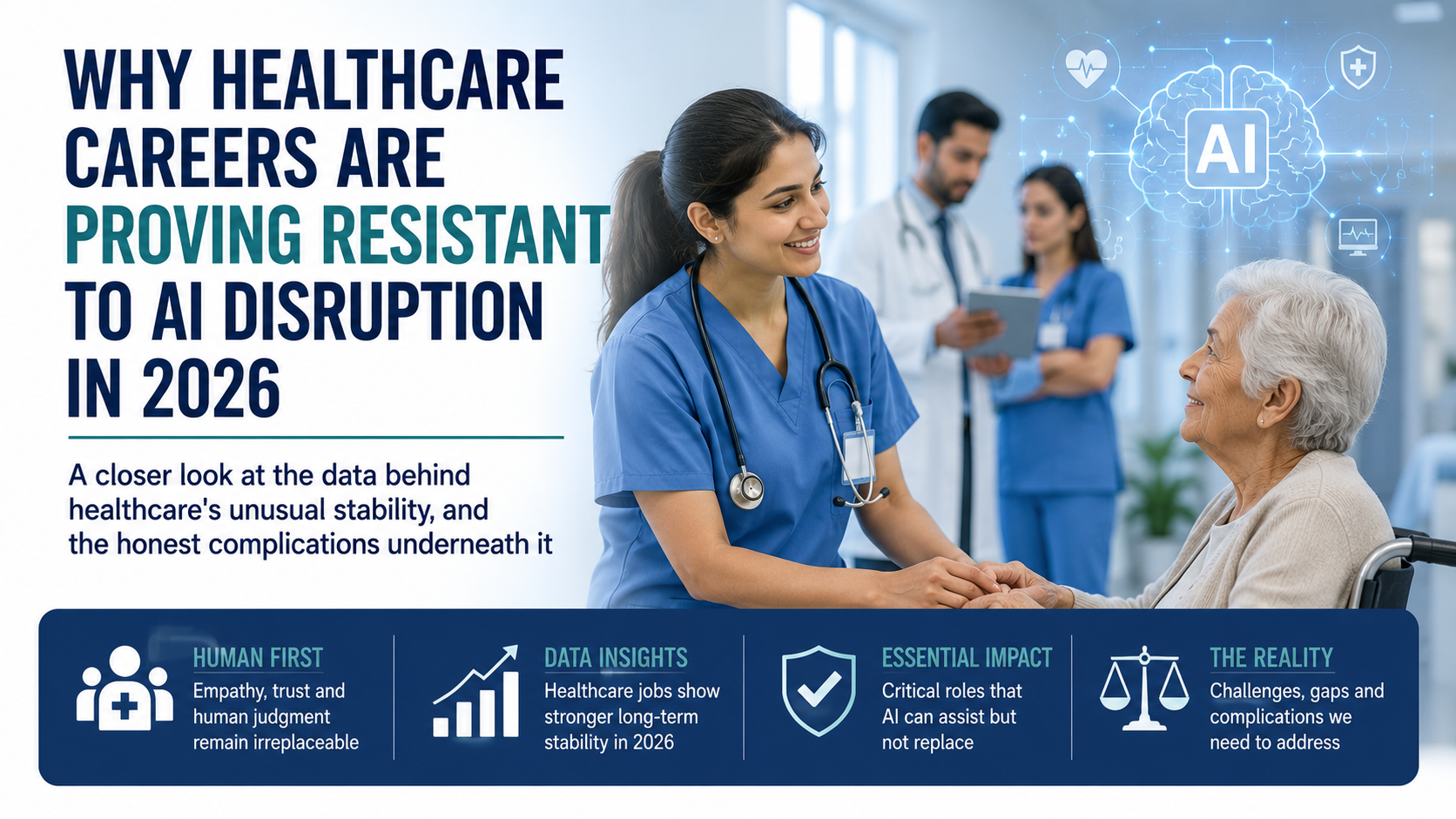
The clearest and best-supported finding across multiple 2026 analyses is that direct, hands-on, patient-facing roles remain strongly resistant to AI displacement. Nursing across its full range of settings – intensive care, emergency departments, medical-surgical units, labour and delivery, travel nursing – continues to top hiring demand rankings. According to a 2025 healthcare market analysis, registered nurses ranked first in hiring volume across the healthcare sector, with licensed practical and vocational nurses ranking fourth and certified nursing assistants ranking eighth. Psychiatric and mental health care, home health support, and physical rehabilitation roles show similar resilience, driven by rising demand and by the fact that these roles depend on qualities – empathy, physical presence, real-time clinical judgment – that current AI tools do not meaningfully replicate.
The demand drivers behind this resilience are structural rather than temporary. An aging population across the United States, United Kingdom, Canada, and Australia is increasing the absolute need for direct care at a pace that outstrips workforce supply, independent of anything happening with AI. This demographic reality means the resilience of direct patient care roles is not simply a temporary reprieve before AI catches up – it reflects a genuine, durable mismatch between what AI can currently do and what an aging population genuinely needs.
Where the picture is more complicated: administrative and documentation-heavy roles
Here is where an honest account needs to depart from the more optimistic headlines. Not every healthcare role is equally protected, and pretending otherwise would be a disservice to readers making career decisions.
Administrative functions within healthcare – medical coding, billing, scheduling, and prior authorisation processing – are experiencing significant and immediate disruption from AI tools. Automated systems increasingly process insurance claims with high accuracy, reducing the volume of manual review these roles previously required. Ambient AI scribes, which listen to patient encounters and automatically draft clinical notes, saw wide adoption through 2025 and continued expansion through 2026, measurably cutting the documentation time that previously consumed hours of clinical staff time daily. This is generally framed as a benefit to clinicians – less time on notes, more time with patients – but it also means that roles built primarily around transcription and documentation face genuine contraction.
A second complicating finding deserves honest attention. Resume Now’s 2026 AI Workforce Preparedness Rankings, based on Lightcast’s Workforce Risk Outlook data, found that healthcare ranks among the worst industries for AI readiness – meaning the gap between how quickly AI skill demands are increasing and how prepared the existing healthcare workforce actually is to meet them is unusually wide. This is a different finding from job security. It does not mean healthcare jobs are at high risk of elimination. It means that healthcare professionals broadly are underprepared for the AI-literacy expectations increasingly attached to their roles, and that this gap represents both a real vulnerability and a genuine opportunity for professionals willing to close it ahead of their peers.
Taken together, these two findings do not contradict the resilience story so much as sharpen it. Direct patient care remains strongly protected. Administrative and documentation-heavy healthcare work is genuinely being reshaped. And AI literacy, even within a resilient field, is becoming a meaningful differentiator between healthcare professionals who advance and those who stagnate.
The new roles emerging at the intersection
A further honest complication – one that is actually good news for readers of this site – is that AI adoption in healthcare is not simply subtracting roles. It is creating a specific new category of position that combines clinical background with technical fluency, exactly the kind of “degree plus” addition this site is built around covering.
Clinical data scientist roles, which apply statistical and machine learning methods to clinical datasets to improve predictive models for patient outcomes and resource allocation, are growing as healthcare organisations move AI tools from pilot projects into standard operations. Healthcare machine learning engineer roles, which design and deploy AI models specifically tailored to clinical environments with attention to safety and regulatory compliance, represent a genuinely new career path that did not exist in its current form five years ago. AI governance and ethics specialist roles are emerging as healthcare organisations grapple with bias, transparency, and the expanding patchwork of state-level regulation governing clinical AI use, since federal frameworks have lagged behind adoption.
These roles sit precisely at the intersection this site’s Medical Plus articles on nursing informatics and health informatics certification have already covered in depth. The 2026 data reinforces what those earlier articles argued: that the strongest position in healthcare right now is not simply holding a clinical credential, and not simply holding a technical credential, but genuinely combining both.
What this means for readers making healthcare career decisions
For a student or early-career professional choosing a healthcare direction, the data supports a clear and specific piece of guidance: prioritise roles built around direct, hands-on patient contact over roles built primarily around documentation, scheduling, or claims processing, if long-term career security against AI disruption is a significant factor in your decision. Nursing, direct therapy and rehabilitation roles, and hands-on diagnostic and treatment support roles show the strongest resilience in the current data.
For a working healthcare professional in an administrative or documentation-heavy role, the honest guidance is to take the disruption in that specific area seriously rather than assuming healthcare’s broad resilience automatically protects your specific position. Medical coding, billing, and scheduling roles are genuinely being reshaped, and building either clinical skills or the AI-adjacent technical skills described above is a more secure direction than remaining purely administrative.
For any healthcare professional at any stage, the AI-readiness gap identified in the Resume Now research is worth treating as a genuine opportunity rather than dismissing it because your specific role feels secure. Healthcare broadly is underprepared for the AI literacy increasingly expected of it. A nurse, technologist, or clinician who builds genuine comfort with the AI tools entering their specific practice area – documentation assistants, decision support systems, diagnostic aids – will be positioned ahead of colleagues who wait for training to be handed to them, which the data suggests is happening slower than the tools themselves are arriving.
How to Identify and Bridge Your Skill Gap After Graduation – A Practical 2026 Guide
How to Get Certified in Health Informatics – A Step-by-Step Guide for 2026
Cybersecurity Certifications for BTech Graduates – An Honest 2026 Guide
The Skills That Will Keep Your Degree Relevant Through 2026 and Beyond
International Nursing Registration in 2026 – NCLEX, NMC, NNAS and AHPRA Compared Honestly
The resilience of healthcare careers in the face of AI disruption is real and well-supported by 2026 data, and it is one of the stronger reasons this site has consistently pointed readers toward the Medical Plus vertical as a durable direction. But resilience is not uniform across every role within healthcare, and the professionals who will do best over the next decade are not simply those who chose healthcare as a category, but those who chose the specific parts of healthcare – and the specific additional skills – that the data shows are genuinely protected.
If you are weighing a healthcare career direction or trying to assess how AI is affecting your specific role, write to me at editor@degreeplusdaily.com. I read every email.