 DegreePlus Daily The skills that make your degree pay off
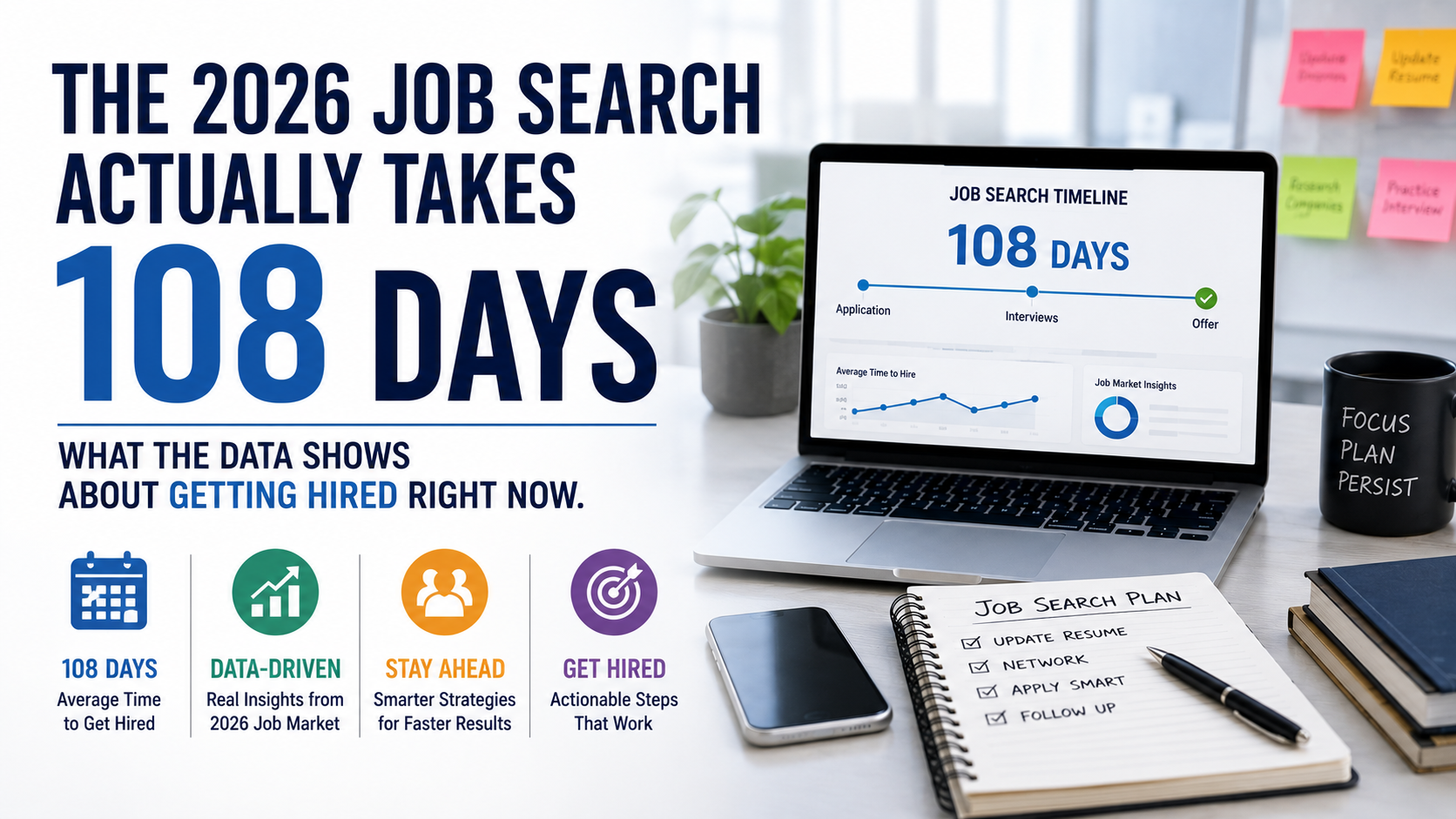
The 2026 Job Search Actually Takes 108 Days – What the Data Shows About Getting Hired Right Now
Fresh data on ghost jobs, withdrawn offers, and how long hiring genuinely takes this year
If your job search feels slower and more discouraging than anything you experienced before, the data backs up what you are feeling. A tracking report released in the second quarter of 2026, drawing on nearly 140,000 tracked applications, 39,000 tailored resumes, and a survey of nearly 600 active job seekers, found that the median time from starting a search to receiving a first offer had climbed to 108 days – up 30 percent from the previous quarter and the longest median recorded since this particular tracking began in early 2025.
I want to walk through this data carefully, because it contains specific, actionable information that most career advice ignores, and because understanding what is actually happening in the market changes how you should approach your own search.
The headline number, and why it matters
A 108-day median search is a genuinely different experience from the 60 to 75 day searches that were typical in previous years. It means the ordinary experience of job searching in 2026 involves roughly three and a half months between deciding to look and receiving your first offer – not your first interview, the first actual offer. For anyone budgeting their finances around a search, or trying to time a resignation from a current role, this number should reset expectations.
The reasons behind the slowdown are structural rather than personal. Employers are moving more cautiously given economic uncertainty. Hiring processes have added steps – more interview rounds, more assessment stages, longer approval chains before an offer is finalised. And the volume of applications per opening has increased, partly because AI tools have made it easier for job seekers to apply to more roles faster, which paradoxically makes each individual application less likely to be seen carefully.
Ghost jobs are a genuine phenomenon, not paranoia
One of the more validating findings in the data is around what job seekers call “ghost jobs” – postings that are not actively being filled. The report found that 93 percent of respondents have applied to a job they believe was fake or not genuinely open, with only 7 percent confident they have never done so. The rate climbs with search intensity: among job seekers who have submitted between one and ten applications, 23 percent report encountering ghost jobs “many times.” Among those who have submitted 26 to 50 applications, that rate climbs to 42 percent.
This matters because it changes how you should interpret silence after an application. A lack of response is not necessarily a reflection of your candidacy. Separate reporting citing workplace research estimates that as much as 20 percent of online job postings may not represent genuinely active hiring – some exist to build talent pipelines for future needs, some to collect resumes for internal benchmarking, some simply because a posting was never taken down after the role was filled or cancelled.
The practical implication is not to stop applying broadly, but to weight your effort toward roles where you have some signal of genuine hiring intent – a recently posted listing, a role at a company you know is actively growing, or ideally, an application that goes through a personal connection rather than a cold submission into an applicant tracking system.
Job offers are being withdrawn at a rate that should change how you plan
This is the finding I think deserves the most attention, because it affects a decision many job seekers make without realising the risk. The first quarter of 2026 saw 18 percent of survey respondents report that an employer withdrew a job offer after extending it – nearly double the 11 percent full-year rate measured across all of 2025.
The pattern within this data is worth understanding specifically. Men reported offer withdrawal at roughly twice the rate of women – 26 percent versus 13 percent. And mid-career professionals carried the heaviest burden of any experience tier: 29 percent of mid-career respondents had an offer withdrawn, a higher rate than either early-career or senior-career respondents.
The practical guidance that follows from this is specific and important. Treat a written offer as conditional until your actual start date, not as a settled fact the moment you receive it. If you are currently employed, do not resign or give notice until the new employer has confirmed that all internal approvals – budget sign-off, background check clearance, any final leadership review – have genuinely cleared. This is uncomfortable advice because it asks you to hold two possibilities in mind simultaneously during an already stressful transition, but the data suggests this caution is now warranted more than it has been in previous years.
AI-related job loss is concentrated in a specific group, and it may not be who you expect
The report found that 18 percent of respondents said they had lost a job to AI or automation in 2026. The distribution of that figure across career stages is the genuinely useful part of the finding: mid-career workers reported losing jobs to AI at nearly double the rate of senior workers – 26 percent versus 14 percent.
This runs against the intuitive assumption that senior, higher-paid roles would be the most vulnerable to AI-driven cost-cutting, or alternatively that junior roles would be most at risk because their tasks are most routine. The data instead points to a specific squeeze on the middle of the career ladder – professionals experienced enough to have accumulated meaningful salary, but not yet senior enough to hold roles built around judgment, relationship management, and strategic decision-making that AI tools cannot yet replicate. This pattern is consistent with separate labour market research finding that workers in AI-exposed entry-level roles have also seen measurable declines in employment opportunities, suggesting the disruption is reaching further into the career ladder than headlines about “entry-level job losses” alone capture.
If you are a mid-career professional reading this, the honest takeaway is that your position is not automatically protected by experience the way it might have been assumed to be a few years ago. The protective factor is not seniority itself, but whether your specific role involves judgment calls, relationship management, and complex human coordination that resist automation – qualities that this site’s earlier article on the skills that keep your degree relevant addresses directly.
The financial pressure behind long searches is real and measurable
Two figures from the report describe the financial reality that a 108-day search creates for many people. Forty-six percent of respondents reported having less than three months of savings to survive without employment. And 71 percent said they had lowered the salary they were willing to accept, described in the report as the deepest combined financial squeeze measured since tracking began.
This context matters because it explains a behaviour pattern that otherwise looks irrational: settling for a lower salary or a lesser-fit role earlier in a search than career advice typically recommends. If you have less than three months of runway and you are 45 days into what the data suggests could be a 108-day median search, the pressure to accept an acceptable offer rather than hold out for an ideal one is not a failure of resolve. It is a rational response to genuine financial constraint, and it is worth planning for before you begin a search rather than discovering it partway through.
The related, uncomfortable finding: 42 percent of respondents said they would use AI to misrepresent parts of their resume to land an interview, with the rate climbing to 52 percent among millennials and 48 percent among mid-career workers specifically. I am not going to offer guidance on resume misrepresentation beyond stating plainly that it carries real professional and legal risk, and that the pressure driving this statistic – a slow, discouraging market – is better addressed through the practical strategies below than through dishonesty that can end a career the moment it is discovered.
One genuinely useful, counterintuitive finding: where you apply matters more than you think
Buried in the report is a specific data point that deserves more attention than it typically receives in career advice. Applications submitted through Google’s job search interface – where Google aggregates postings directly from employer career pages and job boards and routes the application to the employer’s own form – converted to interviews at 7.12 percent, more than double LinkedIn’s conversion rate of 2.94 percent, and the highest rate of any major source measured.
Several specialised job boards also outperformed LinkedIn by a meaningful margin – platforms focused on startups, specific regions, and specific talent pools converted at rates between 3 and 5 percent, compared to LinkedIn’s sub-3 percent figure, despite LinkedIn capturing more total applications than any other single source.
The practical implication is that where you spend your search time matters. LinkedIn remains valuable for networking and visibility, but if your goal is converting applications into interviews efficiently, using Google’s job search directly, and prioritising specialised boards relevant to your industry over generalist platforms, appears to produce measurably better results based on this data.
What this means for your search, specifically
Pulling this together into practical guidance: budget for a search of three to four months rather than six to eight weeks, and plan your finances accordingly before you start rather than discovering the shortfall midway through. Treat any offer as conditional until your actual start date, particularly if you are mid-career, and do not resign from a current role until internal approvals at the new employer have genuinely cleared. Do not interpret application silence as a verdict on your worth – a meaningful share of postings are not genuinely active, and persistence through that noise is simply part of the current market rather than a sign you are doing something wrong. Diversify where you apply, with particular attention to Google’s job search interface and specialised boards relevant to your field, rather than relying primarily on LinkedIn. And if you are mid-career, take the AI displacement data seriously enough to honestly assess whether your current role depends on tasks that are increasingly automatable, and to start building the judgment-based, relationship-dependent capabilities that remain durable.
How to Identify and Bridge Your Skill Gap After Graduation – A Practical 2026 Guide
How to Get Certified in Health Informatics – A Step-by-Step Guide for 2026
Compliance as a Career Path for Law Graduates – An Honest Look at 2026
Cybersecurity Certifications for BTech Graduates – An Honest 2026 Guide
The Skills That Will Keep Your Degree Relevant Through 2026 and Beyond
None of this makes a difficult search easy. What it does is replace guesswork with an accurate picture of what is actually happening in the market right now, so that the decisions you make – how long to hold out for the right fit, when to give notice, where to spend your search effort – are grounded in current data rather than assumptions from a market that no longer exists in the same form.
If you are in the middle of a search and want to share your specific situation, write to me at editor@degreeplusdaily.com. I read every email.