 DegreePlus Daily The skills that make your degree pay off
How to Choose the Right Nursing or Medical Certification – A Decision Framework for 2026
For registered nurses and medical professionals who are surrounded by options and not sure which one is actually right for them
The Medical Plus section of this site now has several detailed articles covering individual certifications: specialty nursing credentials like CCRN and CEN, the nursing informatics pathway and the NI-BC certification, international nursing registration pathways, and the broader health informatics certification landscape through HIMSS. Readers have told me, through emails to editor@degreeplusdaily.com, that after reading these articles the next question they face is: I can see the options clearly now – but how do I actually decide which one is right for me?
This article addresses that question directly. It is a decision framework rather than a credentials guide – a way of thinking through the choice rather than a description of what each credential involves. The individual credentials are covered in depth in the articles linked above. This piece is for the nurse or medical professional who has read those articles, understands the landscape, and now needs to make an actual decision.
Why the choice feels harder than it should
The number of certifications available to nurses and medical professionals has grown substantially, and that growth has made the decision genuinely more complex. In 2000, a US registered nurse interested in specialising typically had a handful of relevant credentials to consider, concentrated in the major clinical specialties. Today, the landscape includes clinical specialty certifications across dozens of practice areas, technology and informatics credentials, international registration credentials, advanced practice certifications, management and leadership credentials, and an expanding set of digital health credentials that did not exist a decade ago.
The proliferation of options is not a neutral development. It has created a secondary industry of certification marketing, where certifying bodies, training programmes, and career advice websites all have interests in making their particular credential sound essential. Cutting through this marketing and making a clear-eyed decision about which certification actually serves your specific career requires applying a consistent framework to the specific situation – not relying on which credential is advertised most prominently or recommended most often in general forums.
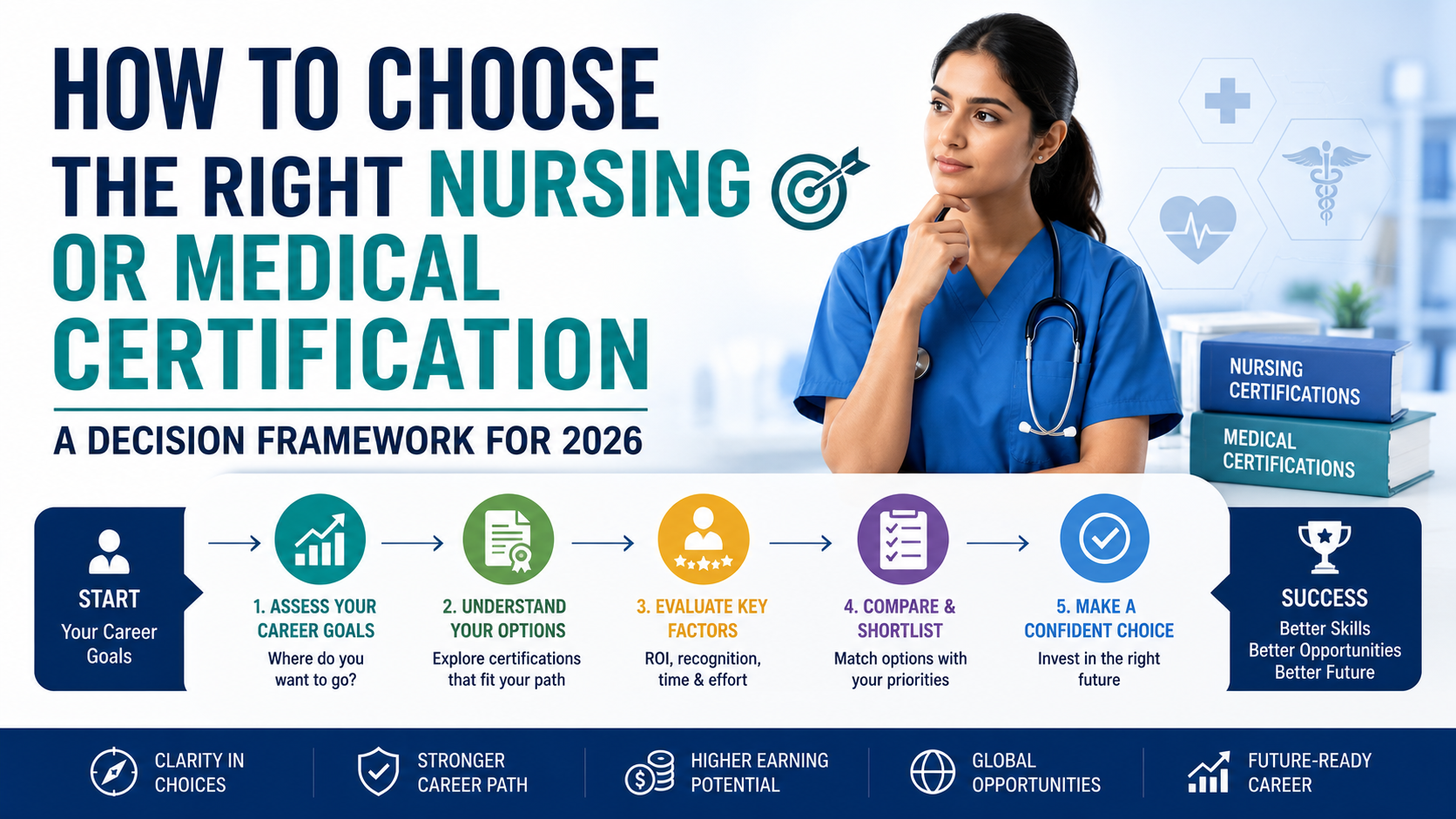
The framework I am going to describe has four parts. They are not sequential steps so much as four lenses to apply to the decision. A certification that looks strong through all four lenses is probably the right choice. One that looks strong through two and weak through two deserves more scrutiny before you invest.
Lens one: Does it match your actual practice, or just your aspirations?
The most consistently useful guide to which certification to pursue is what you are actually doing in your work right now, not what you hope to be doing in two years.
The reasoning behind this is specific. Certification examinations test applied knowledge and clinical judgment in the relevant specialty. Candidates who are actively practising in the specialty accumulate the experience and tacit knowledge that examination questions are designed to test. Candidates who are preparing for a specialty they have not yet entered often discover that the examination asks about judgment calls and contextual details that only become intuitive through practice. The result is that the same candidate who would pass the CCRN comfortably after two years in an ICU may struggle with it while working in a general medical-surgical unit, even after studying the same content.
The practical implication: if you are a critical care nurse planning to take the CCRN, the right time to take it is when you have accumulated the required clinical hours and when the exam content feels like a formalisation of things you already know from experience – not when you want to move into critical care and are using certification as a way to qualify. Examination pass rates are meaningfully higher for candidates who are actively practising in the relevant specialty, and this is not coincidence.
The same principle applies to medical informatics certifications. The CAHIMS from HIMSS is accessible to degree holders with 25 hours of relevant continuing education and 75 hours of informatics experience. A nurse who has been an active EHR super user, participated in implementation projects, and built real informatics practice hours will find the examination tests knowledge they already have. A nurse who has not yet done any informatics work will find the same examination significantly harder and the certification less immediately useful even if passed, because the credential without the practice behind it does not position you for informatics roles.
Ask yourself honestly: does this certification describe what I am doing now, or what I am hoping to do? If it is the former, it is the right choice. If it is the latter, the better investment may be in gaining the practice experience first.
Lens two: Does the employer you are targeting recognise and value it?
Certification value is not universal. A credential that is well-recognised by US hospital systems may carry limited weight in the UK NHS. A certification that commands a pay differential at major academic medical centres may not be offered at community hospitals. A certification valued in critical care may be irrelevant in primary care or ambulatory settings.
Before investing in any certification, verify directly with your current employer or target employers that they recognise the credential and, where relevant, offer a pay differential for it.
This sounds obvious but it is regularly skipped. The career advice ecosystem tends to report aggregate data – “CCRN holders earn more than non-certified ICU nurses on average” – without clarifying that the differential is distributed unequally across employer types. Not every hospital system has a structured pay differential for nursing certifications, and some that do limit the differential to specific credentials they have approved. Calling the HR department or the clinical education team at your target employer and asking specifically “do you offer a pay differential for CCRN certification, and how much is it?” takes five minutes and produces the information you actually need.
For internationally mobile nurses, this lens also means verifying that the certification is recognised in your target country, not just in your home country. US specialty nursing certifications are generally respected in UK private healthcare and in some NHS contexts, but they do not substitute for NMC registration. Australian and Canadian healthcare systems have their own credentialing frameworks. The international nursing registration article published earlier on this site covers this in detail for those considering cross-border practice.
Lens three: What is the honest return on investment?
Every certification requires time and money. The return on that investment – in salary differential, in career progression, in employment options opened – varies significantly, and the marketing around certifications consistently presents the most favourable data rather than the realistic range.
The questions that produce honest ROI analysis are specific. What is the actual salary differential at my specific employer type, in my specific geographic market, for this specific certification? What is the realistic pass rate for someone at my experience level, and what preparation time does that require? What is the total cost – examination fee, preparation materials, time off work if applicable, renewal costs over the credential’s validity period? And what career doors does this certification open that are currently closed to me?
For clinical specialty certifications like CCRN, CEN, or CMSRN, the ROI analysis is reasonably well-supported by data. The differential is real, particularly at larger hospital systems and in travel nursing markets where certified specialists command premium rates. The eligibility gate – the requirement for significant clinical hours before sitting the exam – functions as both a quality control and a filter that keeps the credential meaningful.
For newer categories of certification – digital health credentials, telehealth certifications, AI in healthcare credentials – the ROI data is less established because the credentials and the roles they support are newer. This does not mean these certifications are not worth pursuing. It means the decision should be based more heavily on lenses one and two (practice alignment and employer recognition) and less on published salary differential data, which does not yet exist in the depth it does for established clinical credentials.
For expensive pathways – master’s degrees in nursing informatics, graduate certificates in healthcare administration – the ROI analysis needs to include the opportunity cost of the time invested as well as the direct financial cost. A nurse who spends two years pursuing an MSN in nursing informatics while working full-time is making a significant investment. The question is whether the roles that investment opens are materially better compensated and more satisfying than the nurse’s current trajectory, and whether the same career destination could be reached through a faster or less expensive route.
Lens four: Does this extend your career in the direction you actually want to go?
The fourth lens is the most personal and the most frequently bypassed. It asks a simple but important question: in five years, what type of work do you want to be doing every day? And does this certification move you toward that, or does it move you toward something else that sounds like a good idea but does not actually match what you want from your working life?
The articles published earlier on this site covering nursing informatics and health informatics were explicit about temperament fit – that these paths suit nurses who are genuinely interested in systems, data, and technology, and that they are a poor fit for nurses who are primarily motivated by direct patient care. The same principle applies to every certification category.
A clinical specialty certification deepens your expertise in a specific patient care context. If direct patient care in that specialty is where you want to spend the next decade, this investment makes complete sense. If you are pursuing it because the salary differential is attractive but the work itself does not energise you, you are optimising for the wrong thing – and the salary differential will not compensate for spending the next decade in work that feels like the wrong fit.
A nursing informatics or health informatics credential moves you toward technology, systems, and data and away from the bedside. If that is genuinely where your interests lie, this is a strong and well-supported direction with solid financial outcomes. If you are pursuing it primarily as an escape from bedside pressure without a positive attraction to informatics work itself, the evidence suggests you will find a different set of dissatisfactions waiting on the other side of the credential.
An international registration credential moves you toward cross-border practice and everything that entails – new regulatory environment, cultural adjustment, immigration complexity, distance from established networks. These are significant life decisions, not just career decisions, and the certification is one component of a much larger transition.
Applying the framework
The way to use these four lenses is not to score each potential certification on a checklist but to ask what each reveals that the others do not. Lens one tells you whether the certification is timely for where you are. Lens two tells you whether the market you are targeting values it. Lens three tells you whether the investment is justified financially. Lens four tells you whether it moves you in the direction you actually want to go.
A certification that is timely, employer-recognised, financially justified, and aligned with your genuine direction is easy to decide on. Most certifications look strong on two or three of these dimensions and weaker on one. That is where the framework adds value – it clarifies which dimension matters most in your specific situation and whether the weakness on one lens is disqualifying or acceptable.
The most common mistake I see in how nurses and medical professionals approach certification decisions is letting the marketing around credentials do the analysis for them. Certifying bodies describe their credentials as essential career investments. Career forums tend toward enthusiasm for whichever credentials members themselves hold. Neither source is neutral, and neither applies the four lenses above.
How to Identify and Bridge Your Skill Gap After Graduation – A Practical 2026 Guide
How to Get Certified in Health Informatics – A Step-by-Step Guide for 2026
Compliance as a Career Path for Law Graduates – An Honest Look at 2026
Cybersecurity Certifications for BTech Graduates – An Honest 2026 Guide
The Skills That Will Keep Your Degree Relevant Through 2026 and Beyond
The decision that will serve your career best is the one made after honestly applying these questions to your own situation – not the one that sounds most impressive or is most widely recommended in general. Your career is specific. Your decision should be too.
If you have worked through this framework and still want a specific perspective on your situation, write to me at editor@degreeplusdaily.com with the details of your current role, your practice hours, your target employer type, and your five-year direction. I read every email and will give you an honest response.
Chinnagounder Thiruvenkatam, Publisher and Editor