 DegreePlus Daily The skills that make your degree pay off
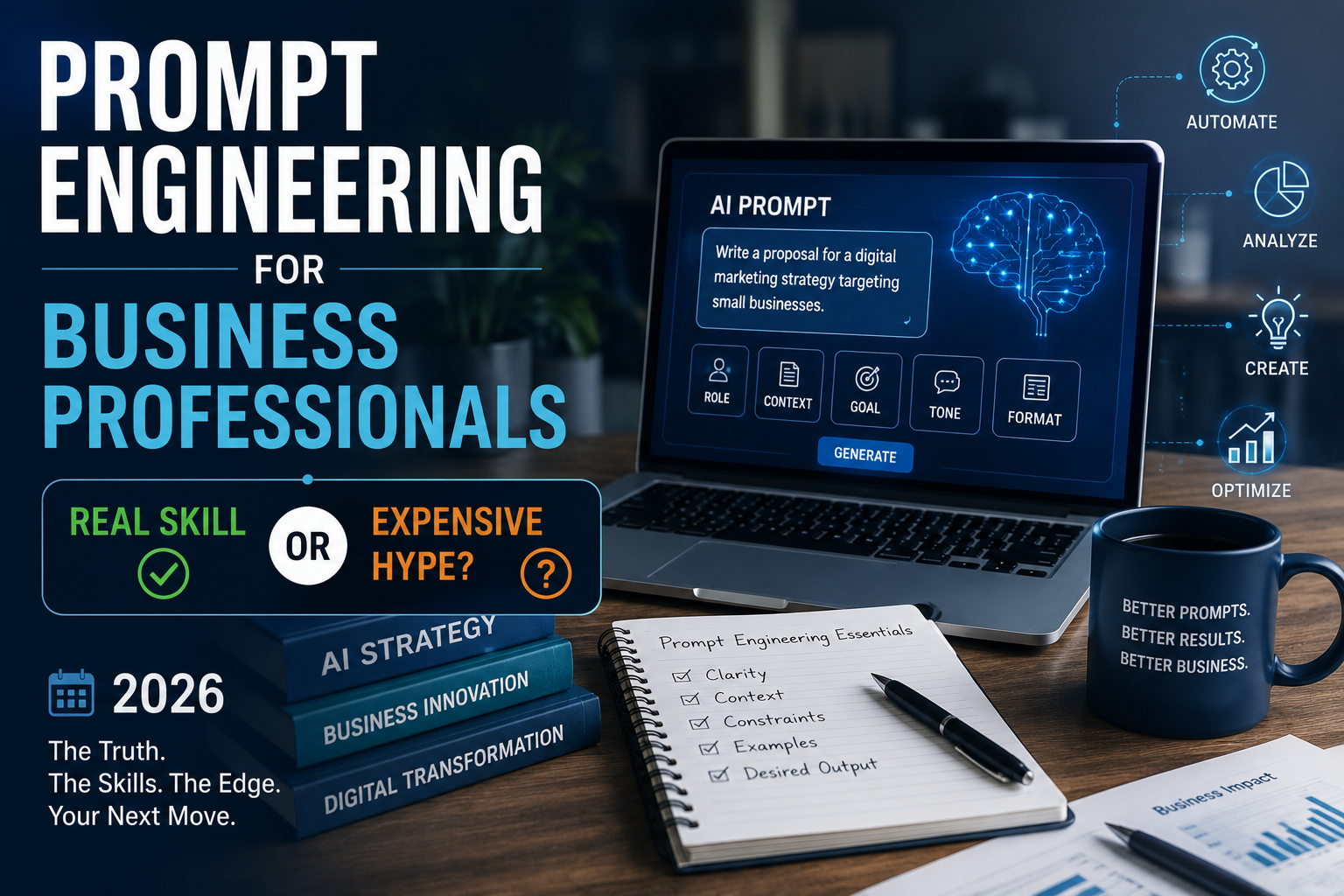
Prompt Engineering for Business Professionals – Real Skill or Expensive Hype in 2026
What has actually changed since 2023, what the salary data shows, and which certifications are worth your money
By Chinnagounder Thiruvenkatam, Published 27 June 2026
In 2023, “Prompt Engineer” was circulating as a potential $300,000 job title. By 2024, the backlash arrived and the counter-narrative became “prompting is just writing – there’s nothing to learn.” In June 2026, neither of those framings is accurate, and both have done harm by leading business professionals to either over-invest in the wrong things or dismiss something genuinely useful.
This article is an honest assessment of prompt engineering as a skill for business professionals – not for AI engineers or technical specialists, but for the accountant, the marketing manager, the HR professional, the compliance officer, and the MBA graduate who uses AI tools daily in their work. The question I am trying to answer is not whether prompt engineering is worth learning in the abstract, but specifically what it means for people in business roles, what the evidence shows about compensation impact, and which investments in learning it are worth making and which are not.
What actually happened to the “Prompt Engineer” job title
The dramatic job title did not materialise in the way 2023 predictions suggested, but the underlying skill did not disappear either. What happened is more interesting: prompt engineering skills got absorbed into a wider set of roles, and the standalone title became less common while the underlying competency became more universal.
According to research from the Prompt Engineer Collective, prompt engineering job postings are up three times in 2026 compared to two years earlier, but the title itself appears less frequently because the skills are now embedded into roles called AI Engineer, Applied ML Engineer, LLM Engineer, and AI Solutions Architect. For technical professionals, this means the skill became a prerequisite for an expanding range of high-compensation roles rather than a standalone career.
For business professionals, the picture is different and arguably more significant. The ForgeCoach Index, which tracks skill demand across professional roles, shows AI Collaboration and Prompt Engineering up 34 points in 2026, categorised as “Rising Fast.” The reason this matters for business professionals specifically is that the demand is not concentrated in technical roles – it is distributed across every function that now uses AI tools to accelerate work.
What prompt engineering actually means for a business professional
The phrase “prompt engineering” sounds technical, but what it means for a business professional is specific and unglamorous: the ability to get consistently useful output from AI tools by structuring your requests carefully and knowing how to iterate when the first output is not right.
This is a genuinely learnable skill with measurable impact on work quality and speed. The research on this is consistent: AI-fluent professionals who know how to direct AI tools effectively produce significantly more output of better quality in the same time than colleagues who interact with AI tools the way most people do – by typing vague requests, accepting mediocre first outputs, and blaming the tool when results are disappointing.
The core capabilities that differentiate effective AI users from ineffective ones are straightforward to list, though not instant to develop. They involve understanding what context to provide – AI tools produce better output when they understand not just what you want but why you want it, who will read it, what constraints exist, and what a good output looks like. They involve understanding how to structure complex requests into components rather than one large ambiguous prompt. They involve knowing when to verify and correct rather than trust – the ability to identify when AI output is wrong, incomplete, or subtly misleading is genuinely important, and it comes from combining AI fluency with domain expertise. And they involve building reusable prompt templates for recurring tasks, which compounds the productivity benefit over time.
None of this is mystical. It is the same kind of craft that makes the difference between someone who knows how to use Excel at a basic level and someone who uses it to actually accelerate analytical work. The skill is learnable, and the productivity difference it makes is real.
The salary impact data is worth presenting directly. Multiple 2026 sources consistently find that AI-fluent workers earn 15 to 30 percent more than their peers in similar roles who are not AI-fluent. This premium comes from the skill itself rather than from certification – the research is clear that it is demonstrable capability that drives compensation, not the credential that certifies it. The certification matters only insofar as it helps someone get to the interview where they can demonstrate the capability.
Where the hype is and where it has led people wrong
The prompt engineering market in 2026 contains a substantial amount of low-quality commercial content that has led professionals to invest time and money in the wrong places. Being specific about this serves business professionals more than a vague warning does.
The most common waste of money is spending several hundred dollars on generic prompt engineering courses that teach theoretical frameworks without connecting them to the specific business context where the learner actually works. A marketing manager who completes a prompt engineering course taught by someone without marketing experience learns abstract techniques that do not transfer to writing better briefs or analysing campaign data. The skill is context-dependent, and the most effective learning happens when the technique is immediately applied to real work in the learner’s specific domain.
The standalone “prompt engineer” certification marketed by commercial providers without recognisable institutional backing is generally not worth the investment. A 2026 review of hiring manager attitudes found that most do not recognise these certifications or weight them significantly. The exception is certifications from established institutions – Google, AWS, IBM, and Vanderbilt University on Coursera each offer credentials that hiring managers in 2026 recognise and consider meaningful signals.
The Vanderbilt University prompt engineering specialisation on Coursera, taught by a computer science professor rather than an AI influencer, costs $49 for the certificate and is the most consistently recommended starting point by hiring managers in the 2026 review. It teaches prompt patterns systematically and is updated regularly. For a business professional who wants a credential that will be recognised on a resume, this is the highest value-to-cost option available.
For business professionals targeting roles in companies that run on cloud infrastructure – which is most larger companies – the Google Cloud AI fundamentals certification or the IBM Generative AI Professional Certificate carry meaningful weight with HR departments and technical hiring managers. These cost more and take longer than the Vanderbilt certificate, but for the right candidate targeting the right roles, they are worth the investment.
For business professionals who do not specifically need a credential – who simply want to use AI more effectively in their current role – the most effective learning path is daily hands-on practice, not a course. Opening an AI tool and working through the specific tasks you actually do, systematically experimenting with how different phrasings and structures change the output, and building a personal library of effective prompts for your most frequent tasks will produce more practical capability than most paid programmes.
What the skill looks like applied specifically in business roles
The promise is not just abstract. Here is what genuine AI fluency looks like in specific business contexts that readers of this site are likely to occupy.
For an MBA or management analyst: the difference between a prompt that produces a generic SWOT analysis summary and one that produces a genuinely useful strategic analysis tailored to a specific company, industry, and decision context is substantial. Learning to structure analysis requests with the right context, constraints, and output specifications changes whether the output requires half an hour of rewriting or five minutes of editing.
For an accountant or financial professional: AI tools can accelerate financial narrative writing, variance explanation, and policy documentation considerably. The professionals who use these tools effectively have learned to provide the specific numerical context, audience, and communication objective in their prompts rather than expecting the tool to infer them. The output quality difference is dramatic.
For a marketing or communications professional: effective AI prompting in marketing requires understanding brand voice, target audience, tone calibration, and the specific purpose of each piece of content. Professionals who bring this context to their prompts produce output that requires genuine editing rather than wholesale rewriting.
For a compliance or legal professional: AI tools can help with policy drafting, research summarisation, and gap analysis. The professionals who use them safely know what categories of work require human judgment and verification, and they build verification steps into their workflow rather than treating AI output as finished product.
The common thread is that the skill multiplies when combined with domain expertise. Prompt engineering without domain knowledge produces generic output. Prompt engineering with deep domain knowledge and careful context-setting produces genuinely useful starting points that the professional can then refine with the judgment that AI cannot replicate.
A specific recommendation for business professionals
The honest recommendation I would make to a business professional trying to develop this skill in 2026 is this.
Start by spending two weeks of deliberate practice – not a course, not a certification, just practice – on the specific AI tasks you do most frequently in your current work. For each task, experiment systematically with different ways of providing context. Keep notes on what works and what does not. Build a folder of the best prompts for your most frequent use cases. This single habit, sustained for two weeks, will produce more practical improvement than most paid programmes.
If after that practice you want a structured framework and recognisable credential, spend $49 on the Vanderbilt Coursera certificate. It will provide the vocabulary and systematic approach that organises what you have already discovered through practice, and it is the credential most likely to be recognised if you list it on a resume or LinkedIn profile.
Only invest in more expensive cloud-provider certifications if your target employer specifically values them and you are working toward a role that explicitly requires or prefers those credentials. For most business professionals, the Vanderbilt certificate combined with a demonstrable track record of using AI tools effectively in real work is sufficient.
How to Identify and Bridge Your Skill Gap After Graduation – A Practical 2026 Guide
How to Get Certified in Health Informatics – A Step-by-Step Guide for 2026
Compliance as a Career Path for Law Graduates – An Honest Look at 2026
Cybersecurity Certifications for BTech Graduates – An Honest 2026 Guide
The Skills That Will Keep Your Degree Relevant Through 2026 and Beyond
What is never worth the money is a certification from a provider nobody has heard of. The credential is only valuable to the extent that the person reading your resume recognises it as meaningful. Generic online certifications that are not from established institutions function as noise rather than signal.
The underlying skill is genuinely valuable and worth developing. The formal credential market around it is noisier than it should be, and most business professionals will extract more value from focused practice than from formal programmes. That is the honest answer, and it is probably not what the training industry wants you to hear.
If you have specific questions about which AI tools are most useful for your particular business function, write to me at editor@degreeplusdaily.com. I read every email.