 DegreePlus Daily The skills that make your degree pay off
Product Management as a Career for BTech Graduates – The Path, the Skills, and What Entry Actually Looks Like
An honest examination of one of tech’s most searched career pivots
By Chinnagounder Thiruvenkatam, Published 27 June 2026
Ask a room full of BTech students what career they want, and somewhere between “software engineer at Google” and “data scientist,” someone always says “product manager.” It has become, in the last few years, the aspirational answer to the question of what to do with a technical degree if you do not want to write code for the rest of your life. The compensation numbers circulate on LinkedIn and Reddit, the job title sounds impressive, and the idea of shaping products that millions of people use has obvious appeal.
The reality is more specific and more nuanced than the aspiration suggests. Product management is genuinely one of the stronger career paths available to BTech graduates – but only for a specific type of person, and the actual entry path is more difficult and more deliberate than most of the aspirational content online acknowledges. This article tries to give you the accurate version.
What the salary data actually shows
Let me start with numbers because they are part of what drives interest in this career, and it is worth presenting them with context.
Glassdoor’s June 2026 data on entry-level product managers puts the average salary at $127,516, with the typical range between $98,267 and $167,668. Salary.com’s June 2026 analysis puts the average at $123,829 for entry-level roles, with California, Massachusetts, and the District of Columbia all exceeding $134,000 at the state average. ZipRecruiter’s June 2026 data puts the average higher, at around $159,405, with the range stretching from approximately $51,500 at the low end to above $197,000 for top-tier candidates in high-cost-of-living markets.
These figures are not wrong, but they are easy to misread. The spread – from $51,500 to $197,000 for the same nominal “entry-level” title – is enormous and reflects fundamentally different roles. An Associate Product Manager at Google, Meta, or Stripe entering a formal APM programme earns at the top of this range, with total compensation including equity significantly higher than base salary alone suggests. A junior product manager at a small company or a startup entering an informal PM role earns at the bottom, often working across multiple functions without the support structure of a large company’s PM organisation.
The broad parameters to hold in mind: entry-level product management at companies with structured programmes in major US markets pays $90,000 to $125,000 in base salary, with total first-year compensation including equity and bonus frequently reaching $130,000 to $170,000. Mid-career PMs with five to seven years of experience earn $120,000 to $160,000 in base, with senior PMs at top tech companies reaching $170,000 to $210,000 and total compensation packages well above $300,000 at the largest companies. AI Product Managers command a premium across the board, with base salaries in the $130,000 to $200,000 range reflecting the current scarcity of people who can credibly manage AI-powered products.
These are genuinely strong numbers. They are also available only to people who actually do the job well in the right environments, which is where the honest assessment of entry requirements matters.
What product managers actually do – and why a BTech background helps
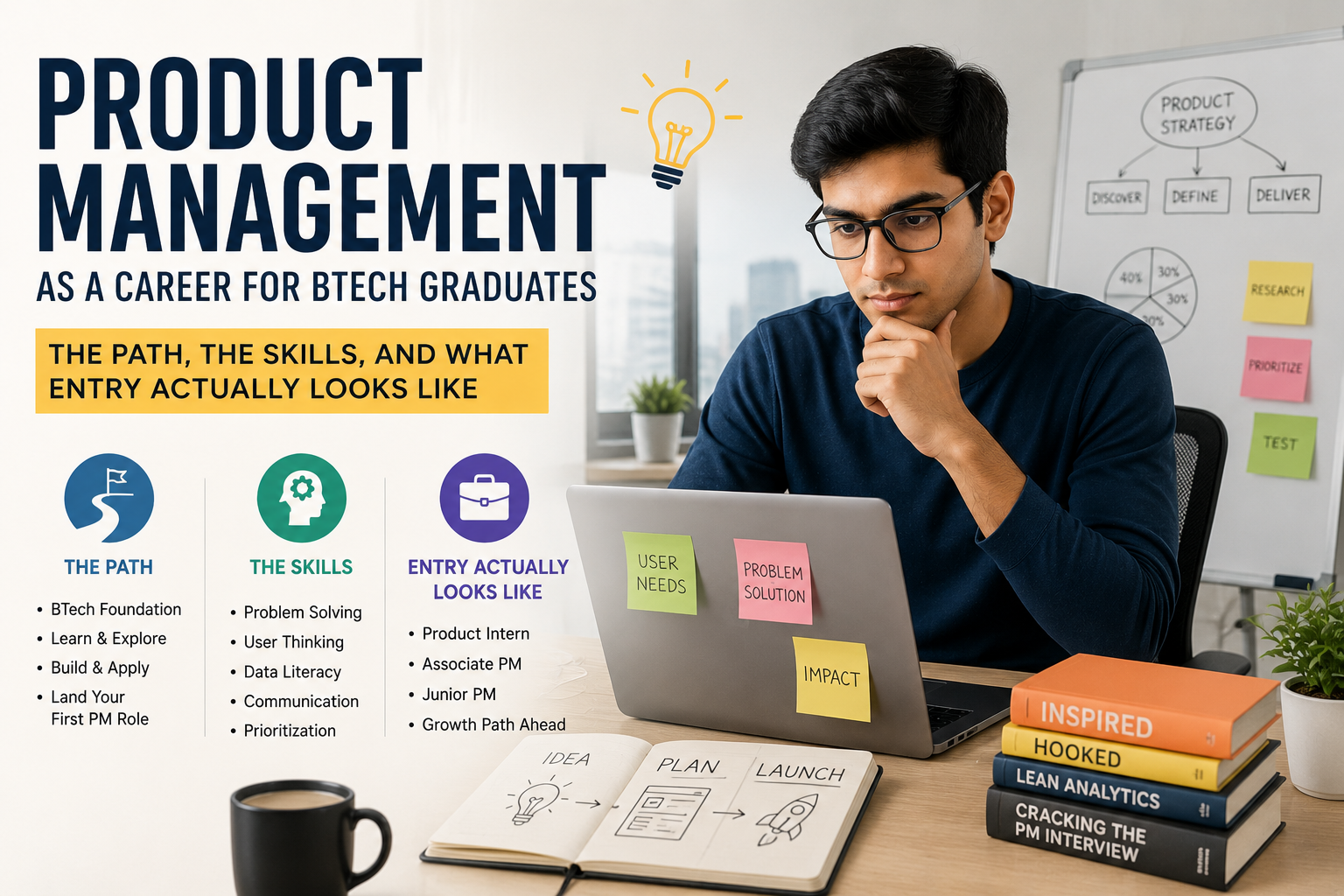
A product manager is responsible for defining what a product should be, why it should exist, who it is for, and how success will be measured. This means working continuously at the intersection of three things: what users actually need, what is technically feasible to build, and what the business requires to grow and remain viable. The product manager is not the person who does the engineering, designs the interface, or runs the marketing campaign. They are the person who holds all of those functions accountable to a shared direction, who makes the prioritisation decisions when competing demands arise, and who takes responsibility when the product succeeds or fails to serve its users.
A BTech background is genuinely valuable for this work, specifically because one of the three intersections – technical feasibility – is the one that non-technical product managers consistently struggle with. A BTech graduate understands how software systems are built, what makes an implementation approach complex or straightforward, and how to have substantive conversations with engineers without having to pretend or oversimplify. This is not a minor advantage. Engineering teams consistently report that the most frustrating PMs they work with are the ones who lack technical grounding and cannot evaluate whether their requests are reasonable to deliver in the time and resources available.
What the BTech degree does not provide, and what separates effective from ineffective product managers, is the user empathy and business judgment dimension. Writing code well does not automatically teach you to question your assumptions about what users want, to seek disconfirming evidence, or to make decisions under uncertainty when the data is ambiguous. Many engineers who move into product management carry a technical bias that leads them to over-weight what is technically interesting at the expense of what users actually need. The product managers who are most effective are the ones whose technical background informs their thinking rather than dominating it.
Why the engineering to product management path is non-trivial
The most common advice BTech graduates receive about entering product management is to “start in engineering and transition after a couple of years.” This advice is not wrong, but it understates how deliberate the transition needs to be to actually work.
The transition path that consistently produces product manager roles runs through specific types of engineering work rather than engineering in general. Software engineers who take on product-adjacent responsibilities – who work closely with design teams, who participate in user research, who advocate for changes in a product’s direction, who lead projects that require coordinating across teams – develop the cross-functional skills that product management requires. Software engineers who spend two years writing excellent backend code without those adjacent experiences develop excellent backend engineering skills, not product management readiness.
The distinction matters because it determines what you need to be doing now, not when you are ready to transition. If product management is your goal, the work of building toward it starts in your current role through deliberate choices about which projects to take on and which relationships to build.
Side projects also matter, and in a specific way. Not the kind of side project that demonstrates you can code. The kind that demonstrates you can identify a real user problem, define a solution, validate your assumptions, and ship something that people actually use. A BTech graduate who has shipped a real product – even a simple web application with a hundred active users – and can speak concretely about what they learned about users, what they would build differently, and how they measured whether the product was working, is a more compelling PM candidate than one who has read all the product management books but never made those decisions with real stakes.
The APM programme path and why it matters for BTech graduates
Major technology companies run Associate Product Manager programmes specifically designed as entry points for recent graduates who want to move into product management. Google’s APM programme, Meta’s Rotational Product Manager programme, Microsoft, Stripe, Salesforce, LinkedIn, and many others offer structured two-year experiences that rotate participants across different product areas, provide mentoring from experienced PMs, and develop the skills that make early-career product managers effective.
These programmes are genuinely the best entry path into product management from a BTech background for several reasons. They provide structure when you do not yet know what you do not know. They provide access to senior PMs who can accelerate your development. And they carry the name recognition that makes subsequent job changes easier, because “Google APM alum” or “Meta RPM” on a resume signals to every subsequent employer that you went through a competitive process and came out competent.
The competition for these roles is real. Google receives tens of thousands of applications for a small number of APM positions. The BTech graduates who succeed in these processes typically have some combination of: a genuine track record of building things (code, products, anything) and learning from the experience; strong analytical capability evidenced by quantitative coursework, internship work, or personal projects; and the ability to articulate a user problem clearly and a thoughtful perspective on how to solve it.
The interview process for APM programmes is different from software engineering interviews. There are no LeetCode algorithm questions. Instead, there are product sense questions (“design a product to help elderly people in India navigate smartphones”), analytical questions (“you are the PM for Google Maps and you see that trips started decreased by 10 percent – what do you do?”), and execution questions about how you would prioritise competing demands, communicate trade-offs, and make decisions with incomplete information. Preparation for these interviews is genuinely useful and learnable, but it requires practising product thinking, not coding problems.
The skills that actually matter, from someone who has examined the data
Two findings from 2026 product management research are worth noting specifically.
The first is that coding skills are not essential for product managers in 2026, but basic technical literacy is non-negotiable. This is the consensus from multiple employer surveys and practitioner interviews. A BTech graduate who can read code, understand database schemas, engage substantively with API documentation, and follow an engineering discussion without getting lost is technically literate in the relevant sense. The ability to write production code is not what is tested or required in PM interviews, with the exception of technical product manager roles at some companies.
The second is that the product managers commanding the highest compensation in 2026 are those who have developed AI product fluency – the ability to manage products that incorporate machine learning, generative AI, or data-intensive decision systems. An AI product manager does not need to train models or implement algorithms, but they need to understand model limitations, evaluation frameworks, data quality requirements, and the specific ways AI systems can fail users in production. This is learnable by BTech graduates with the right curiosity, and the premium for this capability in 2026 is real.
What this looks like in practice for a BTech graduate
A BTech graduate who genuinely wants to pursue product management should be doing three things.
First, developing a genuine and specific perspective on a user problem in a domain they know well. Not “I want to build products for Indian students” as an abstract aspiration, but a specific, evidence-based view on what the unmet need is, how it manifests in people’s lives, and what a useful solution would look like. This perspective is what drives interesting answers to product sense interview questions and what distinguishes candidates who have actually thought about users from those who have learned to sound like they have.
Second, accumulating cross-functional experience either through a side project, an internship with product responsibilities, or deliberate repositioning within a current engineering role. The goal is to have genuine decisions to talk about – moments where you had to trade off between what users wanted, what was technically feasible, and what the business needed.
Third, preparing specifically for product management interviews with the companies whose programmes they are targeting. The analytical and product sense dimensions of these interviews are learnable, but they require practising a type of thinking that engineering coursework does not develop. Books by experienced practitioners, practice questions from people who have been through these processes recently, and mock interviews with people familiar with the format all contribute.
How to Identify and Bridge Your Skill Gap After Graduation – A Practical 2026 Guide
How to Get Certified in Health Informatics – A Step-by-Step Guide for 2026
Compliance as a Career Path for Law Graduates – An Honest Look at 2026
Cybersecurity Certifications for BTech Graduates – An Honest 2026 Guide
The Skills That Will Keep Your Degree Relevant Through 2026 and Beyond
Entry into product management from a BTech degree is realistic, the compensation is genuinely strong, and the career trajectory is one of the better ones available to technically-oriented people who are more interested in products than in engineering as an end in itself. But it requires deliberate preparation, specific experience, and honest self-assessment about whether the work itself suits you – not just whether the title and compensation appeal.
If you want to share your specific background and discuss whether product management is a realistic direction for you, write to me at editor@degreeplusdaily.com. I read every email.